

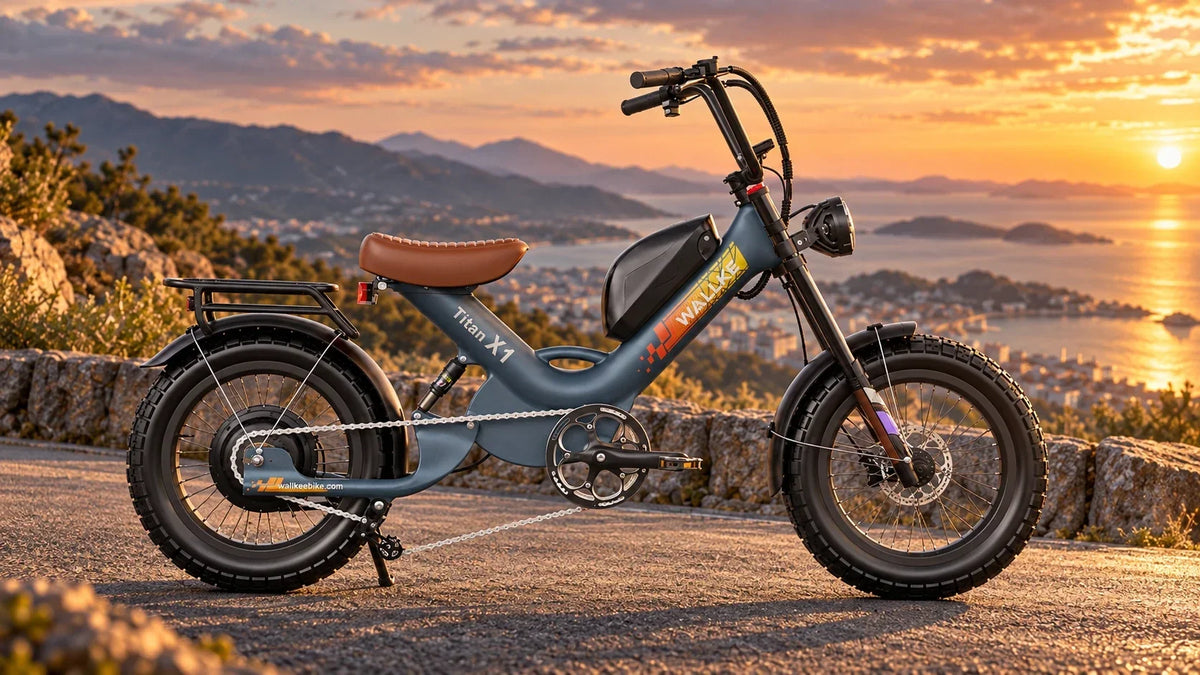
The Titan X1 has never been designed to disappear into a crowd of conventional e-bikes. Its long, motorcycle-inspired silhouette, wide tires and relaxed cruiser stance were part of the idea from the beginning. For 2027, however, we wanted the platform underneath that design to better match its size and intended use.
That led to some major changes: quicker power delivery, a move from a single motor to dual-motor AWD, a larger 48V 45Ah battery, a high-carbon-steel frame and the addition of a rear rack.
But those headline changes are only part of the story. The current 2027 WALLKE Titan X1 AWD also combines a 190 N·m torque rating, 20×5-inch fat tires, 4-piston hydraulic brakes, front and rear suspension, a full-color display, cruise control, a remote alarm and other features designed around longer and more demanding rides.
Here is a closer look at what changed, what the current specifications mean, and where the Titan X1 fits today.
Previous Titan X1 vs. 2027 Titan X1 AWD
| Feature | Previous Titan X1 | 2027 Titan X1 AWD |
|---|---|---|
| Drive system | Single rear motor | Dual-motor AWD |
| Motor configuration | 2000W rear motor, up to 3800W peak | 1000W front + 1000W rear, up to 4000W peak |
| Power delivery | More gradual response | Retuned for quicker acceleration |
| Battery | 48V 30Ah / 1,440Wh | 48V 45Ah / 2,160Wh |
| Frame | Carbon-fiber construction | High-carbon-steel construction |
| Rear shock | 1500 lb preload specification | 2500 lb preload specification |
| Charger | 48V 3A | 48V 6A |
| Published charging time | 7–8 hours | 6–7 hours |
| Rear rack | None | Included |
Not every current feature is new. Some systems, including cruise-oriented controls, suspension and large hydraulic brakes, continue the Titan X1's cruiser-focused design. The sections below separate major platform changes from the broader equipment package.
1. Quicker Acceleration: More Than a Bigger Power Number
One of the main goals for the 2027 Titan X1 AWD was to change how the bike responds when the rider asks for power.

The previous Titan X1 used a single rear-drive motor. The 2027 model uses a 1000W front motor and a 1000W rear motor, with the current specification listing up to 4000W peak power.
Just as important, the power delivery was retuned. Instead of concentrating propulsion through only the rear wheel, the AWD system can distribute drive through both ends of the bike. For the rider, the intended result is a quicker, more immediate response from lower speeds.
This is most noticeable when:
- pulling away from a stop;
- accelerating on an incline;
- carrying a heavier rider or additional cargo;
- riding on surfaces where distributing propulsion across two wheels is useful;
- asking for stronger response without waiting for a single motor to do all the work.
2. Dual-Motor AWD, 190 N·m and the 48V 45A Control System
The dual-motor architecture changes the character of the Titan X1 more than the peak-power figure alone suggests.
The current specification lists 190 N·m of torque and a 48V 45A integrated controller, divided between a 20A front output and a 25A rear output. In practical terms, the system is designed to coordinate power between the two driven wheels rather than depending on a single rear motor.
That matters on a large fat-tire platform. Strong low-speed response, hill starts and maintaining momentum can be more important in daily use than chasing a theoretical maximum-speed number.
WALLKE currently lists climbing capability at 40°+. As with any climbing specification, real-world performance depends on rider and cargo weight, battery state of charge, tire grip, surface conditions and the length of the climb.
3. From 30Ah to 45Ah: A 2,160Wh Battery Platform
The previous Titan X1 used a 48V 30Ah battery. The 2027 Titan X1 AWD moves to 48V 45Ah.

That is a 50% increase in amp-hour capacity. Because both systems operate at 48V, nominal stored energy increases from about 1,440Wh to 2,160Wh.
A larger battery is especially relevant on a dual-motor e-bike because riding style has a major effect on energy consumption. Frequent hard acceleration, high speeds, steep hills and regular dual-motor use can all increase power demand.
WALLKE lists a current riding range of 30–80 miles using pedal assist and throttle. That is a range window, not a promise that every rider will reach 80 miles.
Actual range can change substantially with:
- rider and cargo weight;
- average speed;
- terrain and elevation;
- temperature;
- tire pressure;
- throttle use;
- pedal-assist level;
- how often both motors are engaged.
4. A 6A Charger for a Much Larger Battery
Increasing battery capacity without considering charging time would create another problem. The previous Titan X1 used a 48V 3A charger, while the 2027 Titan X1 AWD comes with a 48V 6A charger.
WALLKE lists a full charging time of approximately 6–7 hours. That gives the 45Ah battery a more practical overnight charging window despite its substantially larger capacity.
Charging time can still vary with battery temperature, starting state of charge and other operating conditions.
5. Why We Moved From Carbon Fiber to High-Carbon Steel
The previous Titan X1 used carbon-fiber construction. Carbon fiber is a legitimate high-performance engineering material with an excellent strength-to-weight and stiffness-to-weight ratio when correctly designed.
But the direction of the Titan X1 changed.
The 2027 platform now has two motors, a 45Ah battery, a rear rack and a broader focus on substantial cruiser-style utility. Minimum frame weight was no longer the primary design objective.
For the new model, we moved to a high-carbon-steel, seamless, streamlined frame. The goal is not to claim that steel is universally better than carbon fiber. It is to use a frame architecture that better fits the priorities of this version of the Titan X1.
Those priorities now include:
- integrating a dual-motor AWD drivetrain;
- accommodating the larger 48V 45Ah battery;
- supporting the substantial motorcycle-inspired platform;
- adding practical cargo capability;
- prioritizing stability and a planted cruiser-style feel over minimum weight.
This also creates an important trade-off: the 2027 Titan X1 AWD is not a lightweight e-bike. The published bike weight is 138.82 lb. Riders who need to carry a bike upstairs, lift it into a vehicle frequently or store it in a tight apartment should consider that before buying.
6. Front Suspension: Air-Sprung Comfort and Control
A bike this large needs more than wide tires to manage broken pavement, expansion joints, gravel and uneven paths.
The 2027 Titan X1 AWD uses a 20-inch inverted air suspension fork.

Unlike a fixed spring setup, the air-sprung fork allows riders to adjust air pressure to better match rider weight, riding style and road conditions. This gives the front suspension more flexibility when setting up the bike for different riders and surfaces.
On rougher surfaces, the fork helps reduce sharp impacts transferred from the front wheel to the handlebars and rider, improving comfort and front-end control.
The goal is not to turn the Titan X1 into a lightweight mountain bike. It is to give a heavy cruiser-style e-bike a more controlled and comfortable front end when the road is less than perfect.
7. Rear Suspension With a 2500 lb Preload Specification
Suspension is not limited to the front of the bike.
The current Titan X1 AWD specification lists a built-in rear oil-spring suspension unit with a 2500 lb preload specification, compared with the 1500 lb preload specification published for the previous Titan X1.
On a long cruiser-style chassis, rear suspension helps isolate the rider from impacts that would otherwise travel directly through the rear wheel and frame into the saddle.
Combined with the front fork and 20×5-inch tires, it gives the Titan X1 a full-suspension layout aimed at comfort and stability rather than the rigid feel of a minimalist commuter.
8. 20×5-Inch Fat Tires: A Big Part of the Titan X1 Feel
The Titan X1 uses 20×5-inch fat tires. Their extra width is a major part of the bike's appearance, but it also changes how the bike feels on the road.
WALLKE describes the current tires as wear-resistant, quiet and built with an integrated anti-puncture layer, together with thickened inner tubes.
The larger tire volume can help absorb small surface irregularities and contributes to the planted, substantial feel expected from a cruiser-style fat-tire e-bike.
Tire pressure remains important. The current product guidance lists a recommended pressure of 23–25 psi. Correct pressure affects handling, comfort, rolling resistance and range.
9. 4-Piston Hydraulic Brakes and 203mm Rotors
A large, fast and heavy e-bike also needs a braking system designed around that mass.
The 2027 Titan X1 AWD uses 4-piston hydraulic disc brakes with 203mm front and rear rotors. The product specification lists both rotors at 2.3mm thickness.

Four-piston calipers apply braking force through multiple pistons at each caliper, while the large rotors provide additional braking leverage and heat capacity compared with much smaller bicycle rotors.
The system also includes brake motor cut-off functionality, so braking input can interrupt motor drive rather than asking the brakes and motors to work against each other.
10. Remote Alarm: An Extra Layer When the Bike Is Parked
A high-value e-bike often spends part of its life parked outside a store, workplace or destination. The current Titan X1 AWD configuration includes a remote alarm as an additional theft-deterrence feature.
The practical value is simple: it gives the rider an additional security layer when the bike is parked and helps discourage casual tampering.
It should still be treated as a supplement to good physical security. For unattended parking, a strong lock and sensible parking location remain important.
11. Cruise Control for Long, Steady Sections of a Ride
Cruise control remains part of the Titan X1's comfort-oriented riding experience.
Once engaged, cruise control is designed to help maintain a steady riding speed without requiring the rider to continuously hold the same throttle position. That can reduce hand fatigue on long, open and relatively constant-speed sections of a ride.
It is not a feature for every situation. Dense traffic, technical terrain, frequent intersections and rapidly changing road conditions all require direct and immediate speed control from the rider.
Riders should use cruise control only where conditions and local rules allow, keep full attention on the road and remain ready to take manual control.
12. Full-Color LCD and Three Pedal-Assist Levels
The 2027 Titan X1 AWD uses a 5-inch full-color LCD display.

The display provides key riding information including:
- pedal-assist level;
- battery level;
- current speed;
- mileage;
- headlight status;
- brake status.
The current specification lists three pedal-assist levels. Rather than treating maximum output as the only useful setting, the rider can choose a lower or higher assistance level depending on speed, traffic, terrain and battery priorities.
13. Rear Rack, Full-Coverage Fenders and Integrated Lighting
The previous Titan X1 did not include a rear rack. The 2027 model does.

That sounds like a smaller change than the drivetrain or battery, but it makes the platform considerably more useful for commuting, errands and day trips. Depending on the permitted rack load and compatible accessories, riders can use the rear platform for bags, panniers and other everyday cargo.
Full-coverage fenders help reduce spray from the tires, while the lighting system includes a 48V LED headlight and an integrated rear light with brake-signal function.
These are not headline performance numbers, but they matter every time the bike is used as transportation rather than simply as a recreational machine.
14. 400 lb Payload, Rider Fit and the Reality of a 138.82 lb E-Bike
WALLKE lists a 400 lb maximum payload and a recommended rider height of 5'1" to 6'1" (155–185 cm).
The overall dimensions and relaxed cruiser layout make the Titan X1 very different from a compact folding or lightweight commuter e-bike.
The published bike weight is 138.82 lb, while the 45Ah battery itself is listed at 17.49 lb.
That weight is part of the trade-off behind the new platform. Buyers gain a larger battery, two motors, high-carbon-steel construction, full suspension, large tires and cargo capability, but the bike is correspondingly more difficult to lift and carry.
2027 WALLKE Titan X1 AWD: Key Specifications at a Glance
Who Is the 2027 Titan X1 AWD For?
The Titan X1 AWD is not trying to be the lightest e-bike or the easiest bike to carry up a flight of stairs.
It makes more sense for riders who place greater value on strong acceleration, dual-motor drive, a large battery, wide tires, full suspension, substantial braking hardware and a motorcycle-inspired cruiser layout.
It may appeal to riders looking for:
- a dual-motor electric bike with AWD;
- a powerful fat-tire e-bike;
- a motorcycle-style electric cruiser;
- a large-capacity battery for longer recreational rides;
- full suspension for mixed urban and recreational surfaces;
- strong braking hardware on a heavier platform;
- cruise control and remote-alarm convenience;
- a rear rack for everyday cargo utility.
More Than a Model-Year Update
The 2027 Titan X1 AWD is not simply the previous bike with a different badge. Its drivetrain, battery, charging system, frame strategy, rear suspension specification and cargo utility have all changed.
At the same time, the features that define the Titan X1 as a cruiser remain: 20×5-inch fat tires, full suspension, a relaxed riding layout, large hydraulic brakes, smart display, cruise-oriented controls and a distinctive motorcycle-inspired profile.
The result is a heavier and more substantial Titan X1, but also one designed around quicker power delivery, more stored energy, AWD capability and broader everyday use.
Shop the 2027 WALLKE Titan X1 AWD
See current pricing and purchase options for the 2027 WALLKE Titan X1 AWD.


Leave a comment