
2026 Heavy-Rider E-Bike Comparison: Payload, Power, Range & Fit
A heavier rider does not automatically need the most powerful e-bike. The better approach is to start with total payload capacity, then compare braking, wheel and tire support, motor performance, range, fit, and the terrain you actually ride.
This updated guide compares six current e-bikes from different brands, then gives more specific guidance for 250 lb, 300 lb, 350 lb and near-400 lb riding situations. Wallke is included as one of the options rather than treated as the only answer.
Quick Answer: What Is the Best Electric Bike for Heavy Riders?
There is no single best e-bike for every heavy rider. Based on current manufacturer-published specifications, the Velotric Nomad 2 stands out for its 505 lb maximum payload, the Mokwheel Basalt for a 450 lb payload with an all-terrain setup, and the Wallke H9 AWD for riders who specifically want dual-motor traction with a 400 lb max payload. Aventon Aventure 3, Himiway D5 Zebra and Radster Trail are also relevant depending on fit, range and riding style.
How We Chose the Bikes in This Guide
This is a specification-led buying guide, not a claim that we independently road-tested every competitor model. We reviewed current manufacturer-published specifications on August 26, 2026 and focused on models with relatively high payload ratings plus braking, tire, motor and range characteristics that can matter to heavier riders.
Important: manufacturer range figures are not directly comparable because test conditions differ. Rider weight, terrain, temperature, tire pressure, speed, throttle use and assist level can all change real-world range. Prices and specifications can also change, so confirm the current product page before buying.
Best E-Bikes for Heavy Riders in 2026: Our Shortlist
The list below is organized by the riding need each model appears best suited to based on published specifications. A higher payload number does not automatically make a bike better for every rider; fit, braking, terrain and ride feel still matter.
| Model | Published Payload | Motor / Torque | Published Range | Tires | Best Fit |
|---|---|---|---|---|---|
| Velotric Nomad 2 | 505 lb | 750W / 90Nm | Up to 65 mi | 26×4.0" | Highest published payload in this shortlist |
| Mokwheel Basalt | 450 lb | 750W / 90Nm+ (1100W peak) | 60–80 mi | 26×4.0" | High-payload all-terrain riding |
| Wallke H9 AWD | 400 lb | Dual 1000W / up to 150Nm combined | 30–80 mi | 20×4.0" | Dual-motor traction, hills and mixed terrain |
| Aventon Aventure 3 | 400 lb total weight limit | 750W / 80Nm | Up to 65 mi | 26×4.0" | Balanced fat-tire all-terrain use |
| Himiway D5 Zebra | 400 lb | 750W / 86Nm | 60–80 mi | 26×4.0" | Long-range fat-tire riding |
| Radster Trail | 370 lb | 750W / 100Nm | 25–65 mi | 3" mid-fat | Fit options, natural assist and trail/commuter balance |
Velotric Nomad 2
Best for riders prioritizing maximum payload headroom
- Payload: 505 lb
- Motor: 750W / 90Nm
- Range: up to 65 mi
- Tires: 26×4.0"
The Nomad 2 has the highest published payload in this comparison. It also combines 4-inch fat tires, hydraulic disc brakes and a choice between torque- and cadence-sensor behavior. That makes it a sensible benchmark for riders whose first priority is leaving substantial payload margin.
Trade-off to consider: a high payload rating is only useful if the frame size and riding position fit you well. Check the regular/large sizing before buying.
Mokwheel Basalt
Best for riders wanting 450 lb capacity with 26×4 fat tires
- Payload: 450 lb
- Motor: 750W / 90Nm+
- Range: 60–80 mi
- Tires: 26×4.0"
The Basalt pairs a 450 lb published payload with a 750W motor, 90Nm+ torque, 4-inch tires and hydraulic brakes. It is a strong fit for riders who want a conventional full-size fat-tire layout rather than a folding platform.
Trade-off to consider: the bike itself is substantial, so storage, lifting and transport should be part of the decision.
Wallke H9 AWD
Best for dual-motor traction, hills and mixed terrain
- Payload: 400 lb
- Motor: dual 1000W
- Peak: 3200W
- Tires: 20×4.0"
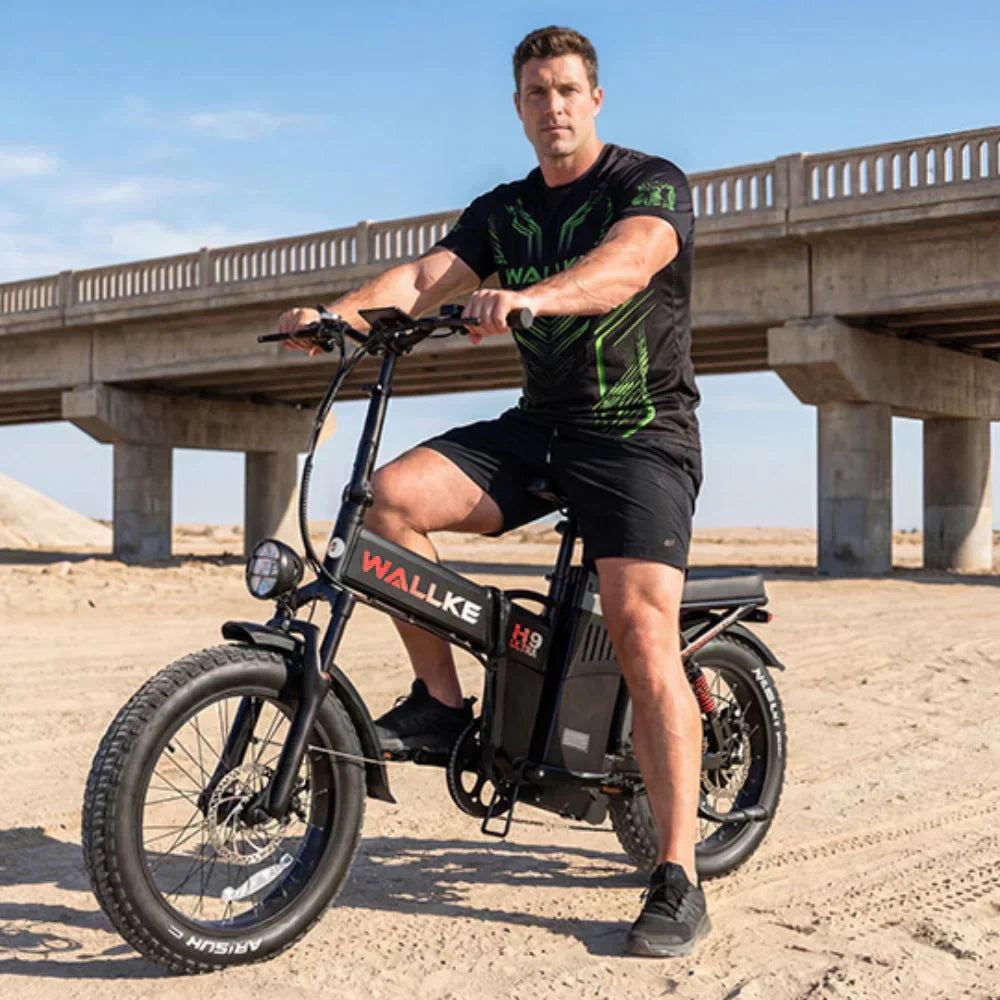
The H9 AWD is the most power-focused option in this shortlist. Wallke currently publishes dual 1000W motors, up to 150Nm combined torque, hydraulic disc brakes, 20×4-inch fat tires and a 400 lb max payload. Its folding frame is useful for storage, but the bike itself is still heavy.
Best reason to choose it: you specifically value all-wheel traction and strong acceleration more than having the highest possible payload number.
Aventon Aventure 3
Best for riders wanting a polished all-terrain fat-tire setup
- Limit: 400 lb total
- Motor: 750W / 80Nm
- Range: up to 65 mi
- Tires: 26×4.0"
The Aventure 3 combines a 400 lb total weight limit with 26×4 tires, hydraulic brakes, a torque sensor and multiple frame sizes. For a rider who values fit, app-connected features and a more conventional single-motor feel, it is a credible alternative.
Trade-off to consider: it offers less motor torque than some of the more power-focused options here, so hill-heavy use deserves extra attention.
Himiway D5 Zebra
Best for riders prioritizing 400 lb capacity and published 60–80 mile range
- Payload: 400 lb
- Motor: 750W / 86Nm
- Range: 60–80 mi
- Tires: 26×4.0"
The D5 Zebra uses a 750W hub motor, torque sensor, hydraulic brakes and 26×4-inch Kenda tires. Its published 400 lb payload and 60–80 mile range make it especially relevant for heavier riders who want a full-size fat-tire bike.
Trade-off to consider: as with every manufacturer range claim, expect rider weight, hills and assist level to reduce real-world distance.
Radster Trail
Best for riders below 370 lb total who value fit and natural assist
- Payload: 370 lb
- Motor: 750W / 100Nm
- Range: 25–65 mi
- Tires: 3" mid-fat
The Radster Trail has the lowest payload figure in this shortlist, but 370 lb is still relevant for many 250–300 lb riders carrying normal gear. Its torque sensor, two frame sizes, hydraulic brakes and 100Nm motor make it worth considering when fit and ride feel matter more than maximum payload.
Trade-off to consider: riders near 350 lb with cargo may have less payload margin than on the 400–505 lb options above.
Spec note: figures above are based on current manufacturer-published pages checked August 26, 2026. They are not independent lab measurements, and range test methods differ by brand.
Which E-Bike Should You Choose by Rider Weight?
Body weight is only the starting point. Add the weight of your lock, backpack, rack bag, tools, water, groceries and other cargo before comparing that total with a bike's published maximum.
Best Electric Bike for a 250 lb Rider
A 250 lb rider has more choices than someone operating near a bike's maximum payload. Instead of automatically buying the heaviest-duty model, focus on leaving sensible payload margin and matching the bike to your terrain.
- Flat commuting: a well-fitted 370–400 lb-rated single-motor bike can provide plenty of capacity for normal gear.
- Hills or loose terrain: stronger torque or dual-motor traction becomes more useful.
- Long-distance riding: prioritize battery capacity and realistic range margin rather than advertised maximum distance alone.
- Fit: rider height, standover and reach can matter more than another 50 lb of unused payload capacity.
For a 250 lb rider, models such as the Radster Trail, Aventon Aventure 3, Himiway D5 Zebra, Mokwheel Basalt, Velotric Nomad 2 and Wallke H9 AWD all provide published payload headroom. The best choice depends on how much cargo you carry and where you ride.
Best Electric Bike for a 300 lb Rider
At around 300 lb, payload margin becomes more important. A 370 lb-rated bike may still work if you carry little cargo, but a 400–505 lb-rated model provides more room for locks, bags, clothing and day-to-day gear.
For flatter riding, a quality 750W single-motor setup may be enough. For frequent hills, starts under load or loose surfaces, higher torque or dual-motor traction can make the bike feel less strained. Hydraulic brakes and strong wheels should be treated as priorities, not extras.
Best E-Bike for a 350 lb Rider
A 350 lb rider should pay close attention to the difference between rider weight and total payload. Once a lock, bag and other gear are added, a 370 lb limit can become restrictive. Models published at 400, 450 or 505 lb offer more usable margin.
At this weight range, check wheel/spoke construction, tire condition and pressure, brake pad wear, frame fit and suspension setup more frequently. Do not assume that a high motor wattage compensates for an inadequate payload rating.
If Your Total Riding Load Is Near 400 lb
If rider plus cargo is close to 400 lb, a 400 lb-rated model is at or near its stated ceiling. In that situation, a bike with a higher published payload rating may be the better fit if all other factors also work for you.
Safety note: never exceed the manufacturer's stated maximum load. If your expected total load is close to the limit, confirm current specifications directly and consider choosing additional payload margin.
What Is the Best E-Bike Motor for Heavy Riders?
There is no single wattage or torque number that is best for every heavy rider. A 250 lb rider on flat pavement can have very different needs from a 300 lb rider climbing steep grades with cargo.
A well-matched 750W rear hub motor can be enough for everyday riding, as shown by several bikes in the shortlist. Higher torque becomes more useful for starts and hills. Dual-motor systems such as the Wallke H9 AWD add front-wheel drive traction and stronger combined output, but they also add weight, complexity and energy use.
Use case matters more than the biggest number: choose stronger torque or AWD for frequent hills, loose terrain and heavier loads; choose a smoother single-motor setup if you mainly ride flatter roads and value efficiency or lighter handling.
Brakes, Wheels and Tires Matter More as Total Load Increases
More total mass means more energy must be controlled during braking and more load is carried through the wheels and tires. For heavier riders, hydraulic disc brakes are a strong preference because they can provide consistent stopping force with less lever effort.
Also look beyond tire width. Fat tires can improve stability and comfort, but wheel construction, spoke condition, tire load capability and correct pressure all matter. A 4-inch tire does not automatically make an e-bike suitable for a heavier rider if the bike's published payload is too low.
Weight Capacity: Use the Published Limit as a Ceiling, Not a Target
The maximum payload number should be treated as an upper limit, not a goal. Your real riding load can include the rider, clothes, helmet, lock, bags, tools, water, cargo and accessories.
We keep this section brief because Wallke already has a separate guide covering the difference between 250, 300, 350 and 400 lb limits in more detail. If you need help calculating total load, read the electric bike weight limit guide.
Which Wallke E-Bike Fits a Heavy Rider Best?
Wallke should not be the automatic answer for every heavier rider. But if your priorities line up with the brand's current strengths—large batteries, fat tires, folding frames and high-power motor options—the H9 AWD and H9 Ultra are the two most relevant models to compare.
Wallke H9 AWD: Best Wallke Pick for Dual-Motor Traction
The current H9 AWD product page lists a 400 lb maximum payload, dual 1000W motors, up to 150Nm combined torque, 20×4-inch fat tires, hydraulic disc brakes and a 48V 40Ah base battery configuration. Wallke also lists 30–80 miles of range for the current configuration.
- Max payload: 400 lb
- Drive system: dual 1000W hub motors
- Peak motor output: 3200W
- Combined torque: up to 150Nm
- Tires: 20×4.0" fat tires
- Best fit: hills, mixed terrain, riders prioritizing strong traction
The main compromise is weight: the current product page lists the bike itself at well over 100 lb, so folding does not mean lightweight.
Wallke H9 Ultra: Best Wallke Pick for Long-Range / Power-Station Use
The current H9 Ultra page lists a 400 lb maximum payload, 20×4-inch tires, 55Ah and 77Ah battery options, and both single- and dual-motor variants. It also uses a torque sensor. This makes it more relevant for riders prioritizing very large battery capacity, longer trips and the model's off-grid power-storage concept.
- Max payload: 400 lb
- Battery options: 55Ah or 77Ah
- Motor options: 2000W rear motor or dual 1000W AWD, depending on version
- Tires: 20×4.0" fat tires
- Sensor: torque sensor
- Best fit: long-distance riding, camping and riders prioritizing very large battery capacity
Because the H9 Ultra has multiple configurations, always confirm the exact motor, battery and weight specification for the version you select.
What Verified Wallke Owners Say About Heavy-Duty Models
Manufacturer specifications explain capacity and components, but owner feedback can reveal practical trade-offs. The comments below summarize themes visible in verified reviews on current Wallke product pages; they are not presented as our own hands-on test results.
Verified H9 AWD feedback includes riders specifically valuing the ability to use dual motors on climbs and a single motor on flatter sections.
Verified H9 Ultra feedback includes owners describing strong power and the ability to handle rough trails and roads that challenged their other e-bikes.
Not every comment is purely positive: at least one verified H9 Ultra owner explicitly called out the bike's weight. That matters if you need to lift it into a vehicle or carry it upstairs.
Heavy Rider E-Bike Buying Checklist
| Check | Why It Matters | Decision Rule |
|---|---|---|
| Total payload | Includes rider plus cargo and accessories. | Leave usable margin below the published maximum. |
| Rider fit | A high-capacity bike can still be uncomfortable or hard to control. | Check height range, standover, reach and seat adjustment. |
| Motor / torque | More useful for hills and starts under load than top speed alone. | Match output to terrain; do not buy by wattage alone. |
| Brakes | More total mass increases stopping demands. | Prefer hydraulic disc brakes and inspect pads regularly. |
| Wheels / tires | Carry the load and influence stability. | Check tire pressure, condition, rim/spoke strength and size. |
| Battery | Heavier loads and hills can reduce range. | Buy enough battery for your real route with reserve. |
| Bike weight | Heavy-duty bikes can be difficult to lift or transport. | Check whether you can store, load and move the bike safely. |
FAQ: Electric Bikes for Heavy Riders
What is the best electric bike for a 250 lb rider?
A 250 lb rider should usually prioritize fit, hydraulic brakes and enough payload margin for cargo rather than simply choosing the highest-capacity bike available. Several 370–505 lb-rated models can provide adequate headroom, depending on terrain and gear.
What is the best e-bike for a 300 lb rider?
For a 300 lb rider, a 400 lb or higher published payload can provide more practical margin for locks, bags and cargo. Hillier routes may also justify stronger torque or dual-motor traction.
What should a 350 lb rider look for?
A 350 lb rider should look beyond motor power and focus on total payload margin, hydraulic brakes, wheel and spoke condition, tire support, frame fit and battery capacity. A 400–505 lb-rated model offers more usable headroom than a bike rated near 350–370 lb.
Can an e-bike carry close to 400 lb?
Yes, some current e-bikes publish 400 lb or higher payload ratings. However, the published maximum should be treated as a ceiling. If rider plus cargo is near 400 lb, consider extra payload margin and verify the exact current specification before riding.
Are fat tire e-bikes better for heavy riders?
Fat tires can improve stability, grip and comfort, but tire width alone does not determine whether an e-bike is suitable for a heavier rider. Payload rating, brakes, wheels, fit and frame design matter too.
Do heavier riders get less e-bike range?
Often, yes. Higher total load generally requires more energy for acceleration and climbing. Speed, hills, temperature, tire pressure, throttle use and assist level also affect real-world range.
Is a dual-motor e-bike better for heavy riders?
Not automatically. Dual motors can add traction and strong acceleration on hills or loose terrain, but they also add weight, complexity and battery demand. A quality single-motor e-bike may be a better fit for flatter everyday riding.
Final Thoughts: Choose the Bike That Fits Your Total Load and Terrain
The best e-bike for a heavier rider is not simply the one with the biggest motor or the highest payload number. Start with a safe total-load margin, then compare fit, brakes, wheel and tire support, motor behavior, battery capacity and the terrain you actually ride.
For the highest published payload in this shortlist, the Velotric Nomad 2 leads at 505 lb. The Mokwheel Basalt follows at 450 lb. Wallke H9 AWD is the strongest fit here for riders specifically prioritizing dual-motor traction, while Aventon Aventure 3, Himiway D5 Zebra and Radster Trail each offer different balances of capacity, fit, range and ride feel.
If Wallke matches your needs, compare the H9 AWD for dual-motor traction with the H9 Ultra for larger battery options and long-distance/off-grid use.


Leave a comment