
A high-end e-bike should earn its price through ride quality, useful hardware, serviceability, or a capability that clearly matches the rider. This guide compares eight very different premium options, from lightweight road and folding bikes to high-capacity Wallke models.

Quick answer
The order is an editorial sequence, not a laboratory score. Each bike serves a different type of rider.
How we selected these high-end electric bikes
We selected models that represent distinct premium use cases: touring, moped-style high-power riding, technical trail riding, long-distance commuting, endurance road riding, cargo and adventure use, high-capacity folding utility, and lightweight folding.
Each bike was reviewed against the same buying questions:
- What type of rider and route is it designed for?
- What motor system, battery capacity, brakes, tires, suspension, and drivetrain does the manufacturer publish?
- How difficult is the bike to store, transport, charge, service, and insure?
- Are replacement batteries, proprietary electronics, and qualified service likely to affect long-term ownership?
- Does the advertised speed or output create legal-access questions?
- Does the premium price buy function, or mostly style?
Range figures are manufacturer claims unless expressly identified as independent measurements. Claims from different brands are not directly comparable because test speed, assist level, rider weight, terrain, temperature, tire pressure, cargo, and stopping frequency vary.
Motor output also requires context. Nominal watts, peak watts, hub-motor output, mid-drive output, torque, and top speed do not describe the same thing. Some models in this guide advertise performance beyond common low-speed electric-bicycle definitions, so buyers must confirm the delivered configuration and the laws that apply to each road, path, or trail.

Best high-end electric bikes of 2026 compared
| Model | Best for | Published motor | Published speed / classification note | Battery | Weight / load note |
|---|---|---|---|---|---|
| Riese & Müller Superdelite5 Rohloff HS | Premium touring and car replacement | Bosch Performance Line Speed; Rohloff E-14; Gates belt | 28 mph configuration; verify local Class 3 access | 1,200Wh dual battery | From 73.2 lb; configuration-dependent |
| Wallke Ravager R60 Series | Very high-capacity moped-style riding | 2,000W rear hub; manufacturer also lists 4,000W peak | Manufacturer lists 44 mph; may fall outside common e-bike class limits | 4,200Wh | R60S 142 lb; R60C 146.5 lb; manufacturer lists 400–500 lb maximum load |
| Specialized S-Works Turbo Levo 4 | Technical trail riding | Specialized 3.1; 850W and 111Nm manufacturer-listed | Trail eMTB; access rules vary by trail system | 840Wh | Confirm size-specific weight and transport limits |
| Wallke H9 Ultra 55Ah | High-capacity folding fat-tire utility | 2,000W rear hub; manufacturer also lists 4,000W peak | Manufacturer lists 37 mph; single motor does not automatically mean Class 1, 2, or 3 | 2,640Wh | Exact single-motor H9 Ultra 55Ah weight requires confirmation; Wallke publishes different weights for other H9 configurations |
| Stromer ST7 | Long-distance premium commuting | 750W U.S. rear hub; 52Nm; Pinion Smart.Shift; Gates belt | U.S. Class 3, up to 28 mph | 1,440Wh | Confirm dealer configuration and transport weight |
| Trek Domane+ SLR 7 | Endurance road riding | TQ-HPR50; 50Nm; 250W continuous / 300W peak manufacturer-listed | Up to 28 mph assistance | 360Wh | 27.89 lb manufacturer-listed for the current model |
| Tern Orox R14 | Cargo, camping, and mixed-surface utility | Bosch Performance Line CX; 85Nm; Rohloff hub; Gates belt | 20 mph U.S. configuration | 800Wh; second battery optional | 83.1 lb; 463-lb maximum gross vehicle weight on pavement |
| Urtopia Carbon Fold 1 | Apartment and multimodal use | 250W rear hub; 450W peak; 42Nm | 20 mph pedal-assist configuration | 252Wh | 29 lb without accessories; 220-lb total weight limit |
MSRP, sale prices, inventory, and dealer configurations can change. “Maximum load” is not automatically the same as cargo payload, rear-rack capacity, or gross vehicle weight rating.
Eight recommended high-end electric bikes
BEST OVERALL PREMIUM TOURING E-BIKE
1. Riese & Müller Superdelite5 Rohloff HS
The Superdelite5 Rohloff HS justifies its premium position through system integration. The 1,200Wh dual-battery setup, 120mm front suspension, 110mm effective rear travel, Rohloff E-14 hub, Gates belt, integrated lighting, and touring equipment are designed to work as one platform.
The 28 mph Bosch Performance Line Speed configuration suits long paved routes and frequent car-replacement use. It is less attractive for riders who need a lightweight bike or simple home maintenance. The manufacturer lists a starting weight of 73.2 lb, and the exact price and weight increase with configuration choices.
Advantages: full suspension, large standard battery capacity, enclosed low-maintenance drivetrain, integrated touring equipment.
Limitations: $14,309 starting RRP, substantial weight, dealer-dependent service, proprietary Bosch and Rohloff systems.
Ownership question: Is there a qualified dealer near your home and along the routes where you plan to travel?
Best for: riders who want a refined long-distance e-bike and expect to use its comfort, battery capacity, and touring hardware regularly.
BEST HIGH-CAPACITY MOPED-STYLE OPTION
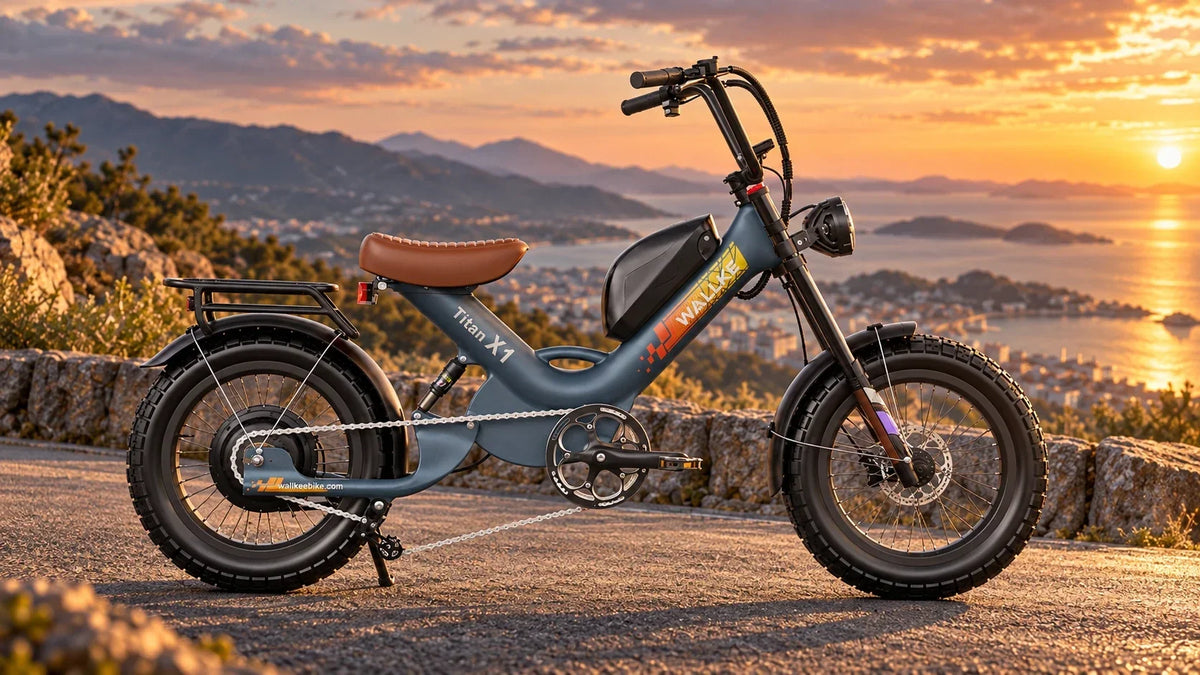
2. Wallke Ravager R60 Series
The Wallke Ravager R60 Series is included for riders specifically seeking very high battery capacity, moped-style construction, wide tires, and high published motor output. It is not a direct substitute for a lightweight premium commuter, road e-bike, or conventional Class 1 trail bike.

Wallke lists a 60V 70Ah battery, equal to 4,200Wh, along with a 2,000W rear hub motor and 4,000W peak output. The company also publishes a 44 mph top speed, 20 × 5-inch tires, four-piston hydraulic brakes, a torque sensor, and bike weights of approximately 142 lb for the R60S and 146.5 lb for the R60C.
The battery capacity is substantially larger than the other models in this comparison. That can reduce charging frequency for some riders, but it also increases replacement cost, overall mass, and transport difficulty. The moped-style saddle and integrated cockpit provide less fit adjustment than the seatpost, stem, and handlebar system on a conventional bicycle.
Wallke publishes several range figures for the R60, including 75–180 miles and a laboratory claim exceeding 180 miles. These are manufacturer claims rather than results independently verified for this comparison. Actual range can fall substantially with speed, throttle use, rider weight, temperature, hills, stops, and tire pressure. See how real-world e-bike range changes before comparing headline mileage.
The R60’s advertised motor output and speed may place the delivered configuration outside the rules that apply to ordinary e-bikes on many public roads, paths, and trails. Buyers should verify federal, state, local, registration, equipment, and access requirements before purchase or use.
Advantages
- Manufacturer-listed 4,200Wh battery
- 20 × 5-inch tires and full-suspension layout
- Four-piston hydraulic brakes and 203mm rotors
- Fast 5–6 hour listed charging time for a 70Ah pack
- R60C and lower-step R60S frame choices
Limitations
- 142–146.5 lb complete-bike weight
- Limited saddle and cockpit adjustment compared with a conventional bicycle
- High long-term battery replacement cost
- Difficult vehicle-rack and stair transport
- Advertised output and speed create public-route access questions

Best for: riders who specifically want a very high-capacity, heavy, moped-style electric two-wheeler and have suitable storage, transport, service access, and a legally appropriate place to ride.
BEST HIGH-END ELECTRIC MOUNTAIN BIKE
3. Specialized S-Works Turbo Levo 4
The S-Works Turbo Levo 4 is the trail-focused choice in this comparison. It is designed for experienced mountain bikers who will use its adjustable geometry, long-travel suspension, braking package, carbon chassis, and electronic drivetrain.
The current U.S. model uses Specialized’s 3.1 motor, listed at 850W and 111Nm, with an 840Wh battery. It pairs 160mm of front travel with 150mm at the rear, a FACT 11m carbon frame, SRAM XX Eagle AXS components, and carbon wheels.
Advantages: powerful trail-specific drive system, 840Wh battery, 160/150mm suspension, adjustable geometry, premium drivetrain and wheels.
Limitations: $11,499.99 price, suspension service requirements, electronic component complexity, and trail-access restrictions that vary by location.
Ownership question: Will you use the high-end suspension and geometry adjustments enough to justify them?
Best for: experienced trail riders who want a full-power eMTB and can make practical use of its suspension, chassis, drivetrain, and adjustment range.
BEST HIGH-CAPACITY FOLDING UTILITY E-BIKE
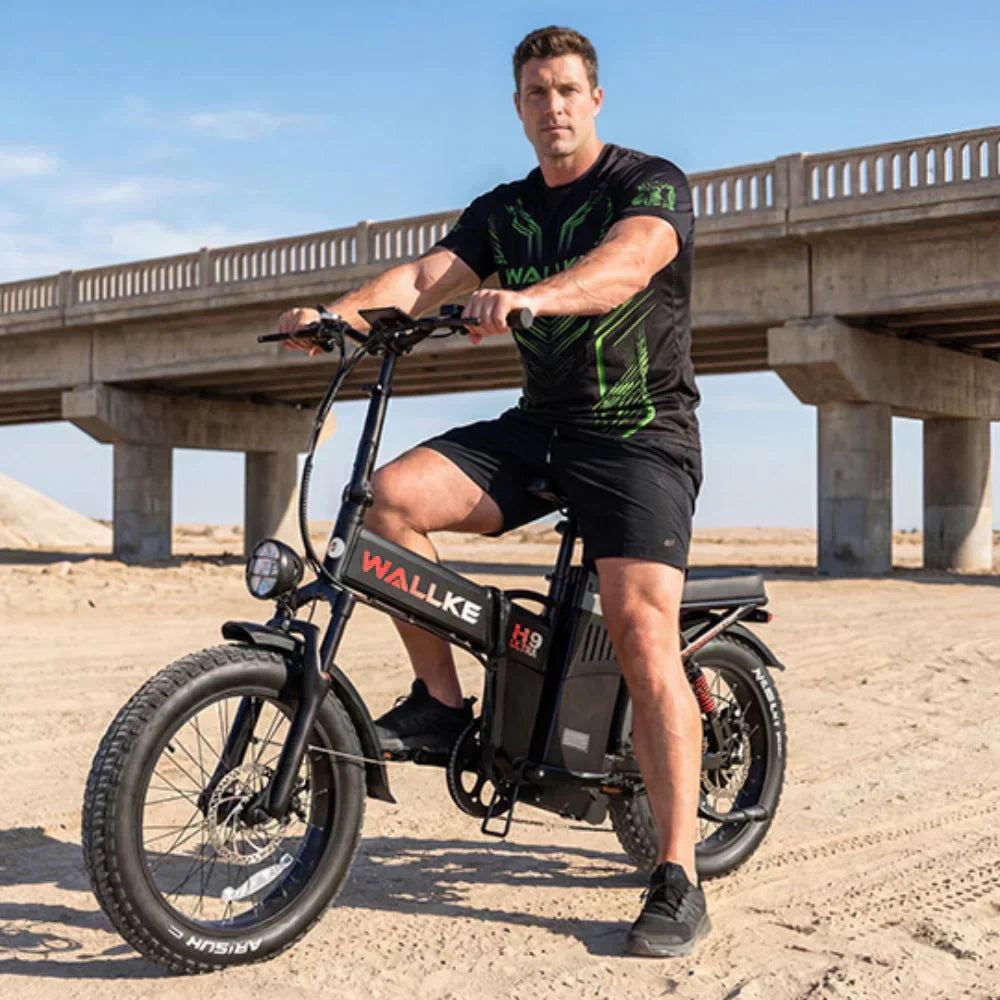
4. Wallke H9 Ultra 55Ah
The H9 Ultra combines a folding aluminum frame, 20 × 4-inch tires, a torque sensor, hydraulic brakes, and a 48V 55Ah battery rated at 2,640Wh. Its folding frame reduces the space required for storage, but this remains a heavy utility bike rather than a folding e-bike designed for frequent carrying.

Wallke lists the single-motor configuration with a 2,000W rear hub motor, 4,000W peak output, and a 37 mph top speed. Choosing the single-motor version avoids the additional weight and mechanical complexity of AWD, but it does not automatically make the bike a conventional Class 1, 2, or 3 model. Buyers must verify the delivered settings and the laws that apply to their roads, paths, and trails.
Wallke currently publishes different range figures across its H9 Ultra pages. The applicable claim should be confirmed for the exact motor and battery configuration before publication or purchase. Any mileage figure used in marketing should be identified as a manufacturer claim.
The off-grid battery feature includes a manufacturer-listed AC outlet rated at 600W, with a 700W maximum. Wallke should confirm the applicable U.S. output voltage against the production-unit label and user manual before publication. Users should follow the manual, operate the system in appropriate conditions, and never exceed its rated or maximum output.
Wallke should confirm the production weight and current price of the exact single-motor H9 Ultra 55Ah variant before publication. Figures published for an H7 Ultra, an AWD H9, or a different battery configuration should not be applied to this model. Before buying, measure stairs, elevator clearance, storage space, and the capacity of any vehicle or hitch rack.
Advantages
- 2,640Wh manufacturer-listed battery capacity
- Folding aluminum frame for reduced storage footprint
- Torque sensor, hydraulic brakes, fat tires, and suspension
- Manufacturer-listed 600W continuous / 700W maximum AC output; U.S. output voltage pending confirmation
- Integrated rack and touring-oriented layout
Limitations
- Heavy for a folding bike
- Eight- to ten-hour listed charging time
- Published range figures are not currently consistent across pages
- Proprietary high-capacity battery adds replacement complexity
- Advertised performance may restrict where it can legally be used
For related motor-selection context, read the guide to single- vs. dual-motor trade-offs.
Best for: riders who prioritize battery capacity, folding storage, fat-tire utility, and campsite device power and who have ground-level storage.
BEST PREMIUM CLASS 3 COMMUTER FOR LONG ROUTES
5. Stromer ST7
The ST7 combines 28 mph U.S. Class 3 assistance with a 1,440Wh battery, Pinion Smart.Shift gearbox, Gates belt, ABS availability, GPS tracking, keyless operation, and integrated commuter lighting. The U.S. motor specification is 750W and 52Nm.
This is a specialized paved-road commuter rather than a general-purpose trail or cargo bike. Its connected features and proprietary systems make dealer access important. Secure indoor parking and insurance also matter because the bike occupies the top end of the commuter market.
Advantages: large battery, enclosed low-maintenance drivetrain, Class 3 road speed, strong security and connected features.
Limitations: dealer-quote pricing, proprietary electronics, high theft exposure, and limited usefulness away from paved commuting.
Ownership question: Do your route, parking, and local Class 3 rules support a high-value speed commuter?
Best for: high-mileage urban commuters with secure storage and access to qualified Stromer service.
BEST HIGH-END ELECTRIC ROAD BIKE
6. Trek Domane+ SLR 7
The Domane+ SLR 7 prioritizes low weight, endurance-road handling, and subtle assistance rather than high motor output. Trek lists a TQ-HPR50 system, 360Wh integrated battery, up to 28 mph assistance, and a current weight of 27.89 lb.
Its $10,999.99 price pays for 800 Series OCLV carbon construction, premium road components, electronic shifting, and a form factor that stays close to a conventional endurance bike. It offers far less utility than the Wallke or Tern models, but that is the point: it is designed for pedaling, climbing support, and road-bike handling.
Advantages: low weight, natural-feeling road assistance, carbon frame, premium drivetrain, and road-specific fit.
Limitations: small battery compared with utility bikes, aggressive fit for some riders, minimal cargo capability, and high replacement-component cost.
Ownership question: Is road-bike fit and low carry weight more important than throttle, cargo capacity, or fat-tire comfort?
Best for: endurance road riders who want climbing support without changing the feel and appearance of a premium road bike.
BEST PREMIUM CARGO AND ADVENTURE E-BIKE
7. Tern Orox R14
The Orox R14 combines an 85Nm Bosch Performance Line CX motor, 800Wh battery, Rohloff 14-speed hub, Gates belt, four-piston brakes, and an adventure-oriented cargo frame. A second battery is optional rather than standard.
For cargo use, the key specification is the load rating. Tern publishes a maximum gross vehicle weight of 463 lb on pavement and 397 lb off-road. Gross vehicle weight includes the bike, rider, batteries, accessories, passengers, and cargo; it is not a 463-lb cargo allowance.
Advantages: serious load design, low-maintenance drivetrain, dual-battery readiness, rider fit from about 5'1" to 6'5", and mixed-surface capability.
Limitations: 83.1-lb bike weight, long wheelbase, accessory costs, and $6,999 sale price.
Ownership question: Which passengers and cargo will you actually carry, and which accessories are required to do it safely?
Best for: families, campers, and utility riders who need a purpose-built, load-rated platform rather than a standard rear rack.
BEST LIGHTWEIGHT PREMIUM FOLDING E-BIKE
8. Urtopia Carbon Fold 1
The Carbon Fold 1 addresses a specific ownership problem: most folding e-bikes are still difficult to carry. Urtopia lists a 29-lb weight without accessories, a two-step fold, 250W rear-hub motor, 252Wh removable seatpost battery, torque sensor, hydraulic brakes, and a 20 mph pedal-assist configuration.
The low weight is useful for stairs, car loading, apartments, and multimodal trips. The trade-off is a smaller battery, 220-lb total weight limit, compact 18-inch wheels, and less comfort on broken pavement than a larger fat-tire bike.
Advantages: 29-lb listed weight without accessories, compact fold, torque sensor, hydraulic brakes, and manufacturer-stated UL 2271 battery certification.
Limitations: 252Wh battery, 220-lb limit, small wheels, and fewer cargo options.
Ownership question: Will you carry the bike often enough for low weight to matter more than battery capacity?
Best for: apartment residents, RV travelers, and commuters who regularly lift or store their bike in a small space.
R60 vs. H9 Ultra: Which Wallke model fits you?
| Decision | Choose R60 | Choose H9 Ultra |
|---|---|---|
| Primary goal | Maximum battery size and moped-style performance | High battery capacity with a folding frame and utility features |
| Battery | 60V 70Ah / 4,200Wh | 48V 55Ah / 2,640Wh |
| Published speed | 44 mph | 37 mph |
| Frame and tires | Fixed moped-style frame; 20 × 5-inch tires | Folding aluminum frame; 20 × 4-inch tires |
| Storage | Requires substantial ground-level space | Folds to reduce footprint, but remains heavy |
| Extra utility | Very large battery and high-output focus | Manufacturer-listed 600W continuous / 700W maximum AC output |
Neither model should be treated as an ordinary bike-path commuter solely because it has pedals or selectable settings. Confirm the exact configuration and applicable laws before riding. Also confirm the exact safety certification standard, certification organization, model number, and public listing; broad “UL” wording alone is not enough.
How much does a high-end e-bike cost?
This comparison spans roughly $1,799 to more than $14,000 because “high-end” describes several different markets. A lightweight carbon folder, a high-capacity moped-style bike, a premium Class 3 commuter, and a top-tier eMTB do not use the same cost structure.
A lower purchase price does not automatically mean lower ownership cost. Before buying, estimate:
- Replacement battery price and availability
- Motor and controller diagnostic access
- Brake, tire, suspension, belt, chain, and drivetrain service
- Insurance and secure-lock requirements
- Vehicle rack or trailer upgrades
- Dealer labor and shipping for warranty work
- Proprietary displays, apps, gearboxes, and electronic shifting components
A premium e-bike is worth considering when the added cost improves fit, braking, serviceability, carrying capacity, storage, or another feature you will use regularly. Do not pay more for weight or complexity that makes daily ownership harder.
How to choose the right premium e-bike
Start with the route
Write down your longest normal round trip, hills, surfaces, legal access, expected cargo, and storage conditions. Add a reserve for cold weather, wind, detours, battery aging, and heavier loads.
Compare watt-hours, then question the range claim
Battery watt-hours provide a more useful starting point than amp-hours alone. They still do not predict exact range. Use Wallke’s guide to estimating practical e-bike range and treat every marketing range as conditional.
Check speed, weight, and brakes together
A heavy or fast electric two-wheeler needs braking, tires, frame construction, and rider skill that match its capability. Do not evaluate speed as a standalone benefit.
Verify battery and charger safety details
Ask for the exact safety standard, certified product identity, certification organization, and public listing. UL 2271 battery certification is not the same as UL 2849 evaluation of an e-bike electrical system. UN38.3 is a lithium-battery transport test, and an MSDS is a safety-data document. For charging and storage practices, see e-bike battery and charger safety.
Test ownership, not just acceleration
- Can you mount, dismount, and stop comfortably?
- Can you remove the battery without straining?
- Can your rack, vehicle, stairs, elevator, and floor support the bike?
- Can a local shop service the motor and electronics?
- Can you buy the correct replacement battery several years later?
- Does the delivered configuration match your local rules?
For broader manufacturer and support comparisons, see the guide to established e-bike brands and service networks.
What e-bikes should you stay away from?
- Unclear safety claims: “UL certified” appears without an exact standard, model, certifier, and public listing.
- Unrealistic range presentation: one large mileage number appears without test conditions or configuration.
- Power without control: high speed is paired with weak brakes, unsuitable tires, or vague frame details.
- No replacement-battery path: the seller cannot confirm future availability or compatibility.
- Hidden ownership constraints: bike weight, load definition, proprietary parts, or service requirements are omitted.
- Legal ambiguity: a product is marketed as a normal bicycle even though its advertised output or speed may exceed common e-bike class limits.
Compare the current Wallke specifications
The Wallke product pages contain current configuration, price, shipping, warranty, and accessory information. Review those details before choosing a variant.
Frequently asked questions
What is considered a high-end e-bike?
A high-end e-bike combines strong category fit, a credible battery and motor system, appropriate brakes and ride hardware, useful support, and premium features that improve ownership. Price and motor wattage alone do not make a bike high-end.
Are expensive e-bikes worth the money?
They can be when the extra cost improves fit, suspension, braking, drivetrain maintenance, carrying ability, battery capacity, service access, or security. They are harder to justify when the premium is mostly styling or a performance claim you cannot legally or practically use.
How much should a high-end e-bike cost?
Premium e-bikes commonly span several thousand dollars, and specialist road, mountain, touring, and connected commuter models can exceed $10,000. Compare ownership costs, service access, battery replacement, and the exact capability you need rather than using one price threshold.
What certification should an e-bike battery have?
Look for the exact applicable standard and public certification record. UL 2271 applies to light-electric-vehicle battery packs, while UL 2849 evaluates the e-bike electrical drive system, battery, and charger as a system. Confirm the certifier, model number, and listing rather than relying on a generic “UL” claim.
What is the best high-end electric mountain bike?
The Specialized S-Works Turbo Levo 4 is the trail-focused pick in this comparison because its premium price is concentrated in the motor system, suspension, carbon chassis, geometry adjustment, brakes, drivetrain, and wheels.
What is the best high-end electric road bike?
The Trek Domane+ SLR 7 is the road-focused pick for riders who value low weight, endurance geometry, a 360Wh integrated battery, subtle assistance, and traditional road-bike handling.
Which Wallke model should I compare: R60 or H9 Ultra?
Compare the R60 when your priorities are maximum published battery capacity, 20 × 5-inch tires, and moped-style performance. Compare the H9 Ultra when you want a folding frame, 20 × 4-inch tires, a 2,640Wh battery, and campsite power output. Both advertise speed and output that may restrict where they can legally be used.


Leave a comment