
A second motor can add traction and climbing force, but it also adds weight, cost, complexity, and energy demand. This guide explains when the upgrade is useful—and when a well-matched single-motor system is the more practical choice.

The quick verdict
Hill-climbing verdict: A dual-motor e-bike is most useful for steep starts, repeated climbs, loose surfaces, and heavy loads because both wheels can contribute drive force. A well-matched single motor is usually sufficient for moderate paved hills and generally offers lower weight, lower cost, and more efficient battery use. Compare sustained output, controller current, battery voltage, total payload, and tire grip—not motor count alone.
Choose a single motor e-bike for mostly paved commuting, moderate hills, easier handling, lower purchase cost, and the best chance of maximizing range from a given battery.
Choose a dual motor e-bike when you regularly face steep climbs, loose terrain, heavy payloads, repeated stop-and-go starts, or conditions where driving both wheels can provide useful traction.
Do not choose by motor count alone. Motor quality, controller tuning, battery capacity, brakes, tires, frame design, total weight, and service support can matter more than whether the bike has one motor or two.
What “single motor” and “dual motor” mean on an e-bike
A single motor e-bike uses one electric motor to drive either the rear or front wheel. Rear-hub systems are common because they provide familiar traction and keep the steering system relatively simple.
A dual motor e-bike normally places one motor in the front wheel and another in the rear. When both are engaged, the bike can drive both wheels. This is often described as an all-wheel-drive, or AWD, e-bike setup.
That basic definition is simple. The riding experience is not. Two bikes with the same motor count can feel very different because of controller programming, sensor type, gearing, wheel size, total mass, and how quickly power is delivered.

Single vs dual motor e-bike comparison
| Decision factor | Single motor | Dual motor | What matters in real use |
|---|---|---|---|
| Acceleration | Usually smoother and easier to manage | Can feel stronger, especially from a stop | Controller tuning and traction limit usable force |
| Steep hills | Capable when the motor, gearing, battery, and load are well matched | Often better for repeated steep climbs or heavy loads | Heat, battery voltage, rider weight, and hill length matter |
| Loose terrain | One driven wheel; predictable for many riders | Two driven wheels may improve forward traction | AWD does not improve braking grip; tires still matter |
| Range | Often more efficient under comparable conditions | Can consume energy faster when both motors are used | Battery watt-hours and riding behavior dominate |
| Weight | Usually lighter | Usually heavier due to the second motor and related hardware | Consider stairs, racks, storage, and low-speed balance |
| Cost | Normally lower purchase and replacement cost | Normally higher upfront cost | Compare the entire bike, not only the motor upgrade |
| Maintenance | Fewer powered components | More wiring, connectors, controls, and motor hardware | Parts availability and support determine repair difficulty |
| Best fit | Commuting, paved recreation, moderate terrain | Steep hills, heavy loads, loose surfaces, performance-focused use | Your normal route should decide—not the most extreme ride imaginable |
Dual Motor vs Single Motor for Hill Climbing and Torque
Short answer: A dual-motor e-bike usually provides the clearest advantage when a ride includes steep starts, repeated climbs, loose surfaces, or a heavy rider-and-cargo load. By driving both wheels, the system can distribute propulsion and reduce the amount of work demanded from one tire and one motor. On moderate paved hills, however, a well-matched single motor may provide all the climbing performance a rider needs with less weight and energy demand.
When dual motor makes a noticeable difference
- Starting on a steep grade: engaging both wheels can provide stronger low-speed pull and make it easier to restart without losing momentum.
- Repeated or sustained climbs: sharing propulsion between two motors may reduce the continuous load placed on a single motor, although controller tuning and thermal limits still matter.
- Heavy riders and cargo: extra drive capacity is most useful when the bike must repeatedly accelerate or climb under a high total payload.
- Loose or uneven surfaces: driving both wheels can help maintain forward motion when one tire begins to lose traction.
When a single motor is usually enough
- Most rides are on paved roads with flat terrain or moderate grades.
- The rider can approach a hill with momentum instead of restarting on the slope.
- The motor, controller, battery, wheel size, and total payload are appropriately matched.
- Lower bike weight, easier handling, longer range, or simpler service matters more than maximum climbing force.
A short 12% ramp can be easier than a long 8% climb, especially if the rider enters the steeper section with momentum. For a meaningful comparison, look at hill length, starting speed, total payload, surface, battery state of charge, sustained output, and whether the test was performed in single- or dual-motor mode—not peak wattage alone.

Traction and stability: what AWD can—and cannot—do
Driving both wheels can help an e-bike move forward when one tire has limited grip. That can be useful on loose climbs or uneven surfaces. It does not create unlimited traction.
More drive force can also cause a tire to spin if the rider applies power abruptly. Front-wheel torque changes steering feel, especially on loose ground or while turning. Riders moving from a conventional commuter e-bike should practice with the lowest power setting first.

Range and battery use: will dual motors drain the battery faster?
Using two motors at high output generally requires more electrical energy than using one motor gently. That does not mean every dual motor e-bike has poor range. Many are paired with larger batteries, and some let the rider switch between single- and dual-motor modes.
For a useful comparison, look beyond advertised miles. Check:
- battery energy in watt-hours (Wh), not only amp-hours;
- whether the range claim uses throttle, pedal assist, or mixed riding;
- the speed and assist level used for the estimate;
- rider and cargo weight;
- terrain, temperature, wind, and tire pressure;
- whether one or both motors were active.
A simple principle helps: using maximum acceleration, high speed, low tire pressure, and both motors together will reduce range compared with moderate pedal assist on level pavement.
Weight, handling, and the part buyers often overlook
Dual motor e-bikes are commonly heavier. The additional mass may feel stable at speed, but it also affects everyday ownership.
Before buying, consider how you will handle the bike when you are not riding it:
- lifting the bike onto a rack;
- rolling it through a narrow doorway;
- turning it around in a garage;
- controlling it at walking speed;
- recovering from a lean while stopped;
- transporting it after a flat tire or electrical fault.
A bike that is impressive on a test ride can become inconvenient if its weight conflicts with your storage or transport setup.

Cost and reliability: is the dual motor upgrade worth it?
Pay for the second motor only when your normal route repeatedly demands more launch force or traction from both wheels. It is harder to justify for a rare “just in case” scenario.
Your normal week looks like this
- Paved commuting
- Moderate grades
- Limited storage space
- You value lower weight and simpler service
- You want to stretch battery range
Your normal week looks like this
- Steep or repeated climbs
- Loose or mixed terrain
- Heavy rider-and-cargo loads
- Frequent low-speed starts under load
- You accept more weight and complexity
Reliability is not determined by motor count alone. A dual motor system has more components that could require service, but build quality, water protection, connectors, controller heat management, parts availability, and manufacturer support are more meaningful than a simplistic “one motor lasts longer” rule.
Before buying a dual-motor e-bike, ask the seller:
- Are the front and rear motors the same specification?
- Does front-wheel service require disconnecting a motor cable?
- Are replacement controllers and displays available?
- If one motor or controller fails, can the bike still operate in a supported single-motor mode?
Why not use one big motor instead of two?
This question appears frequently in rider forums. One larger motor can be a sensible design. It reduces the number of drive motors and may simplify wiring and control.
Two motors offer a different advantage: they can distribute drive force between the front and rear wheels. That may improve traction and low-speed pull in certain conditions. It can also allow selectable operating modes on bikes designed with that feature.
The engineering trade-off is not “weak versus strong.” It is simplicity and efficiency versus distributed traction and additional drive capacity.
When the second motor is usually unnecessary
Do not upgrade for motor count alone when most rides are on flat pavement, you live upstairs, transport the bike on a rear rack, frequently push or turn it at low speed, or prefer a lighter and more natural-feeling commuter. In those situations, added weight may affect daily ownership more often than added traction helps.
Which setup fits common riding scenarios?
Daily urban commuting
A single motor is usually sufficient for paved trips, traffic lights, bike lanes, and moderate grades. It tends to be easier to maneuver and may cost less. Dual motor becomes more relevant when the route includes unusually steep hills, heavy delivery loads, or poor surfaces.
Hilly neighborhoods
Do not judge a hill by grade alone. A short 12% ramp may be easier than a sustained 8% climb under a heavy load. Consider hill length, frequency, total payload, surface, and whether you must restart on the slope. A capable single motor can handle many hills. Repeated steep starts under load are where the added motor may provide a meaningful benefit despite the extra weight.
Sand, gravel, snow, and off-road use
Dual motor drive can help maintain momentum when traction varies between the front and rear tire. Tire tread, pressure, rider technique, and local access rules remain critical. More power cannot make an unsuitable tire or unsafe trail condition disappear.
Heavy riders and cargo
Start with the total payload rating. Add the rider, clothing, locks, bags, accessories, and cargo. Then evaluate brakes, wheels, tires, frame, suspension, and battery capacity. A second motor can improve starts and climbs, but the whole bike must be designed for the load.
Long-range recreational riding
For long paved rides, a single motor often provides the better balance of efficiency and manageable weight. A dual motor model with selectable single-motor operation may provide flexibility, but buyers should verify how each mode works and how the manufacturer produced its range estimates.
Why Wallke offers both single- and dual-motor e-bikes
The return of a high-output single-motor option does not mean dual motors have become unnecessary. It reflects a different set of priorities. Some riders want strong rear-wheel drive and a large battery without the extra front-wheel torque, wiring, weight, and service complexity of an AWD system.
For paved touring, long recreational rides, and riders who frequently move or transport the bike, a single-motor layout may provide a better overall balance. Dual-motor models remain useful when steep starts, loose surfaces, or heavy loads are recurring parts of the route. Offering both layouts lets buyers match the drive system to the route instead of treating motor count as a product hierarchy.
- Compare all Wallke electric bikes when you have not yet decided between single and dual motor.
- Explore Wallke dual motor e-bikes when recurring steep starts, loose terrain, or heavy-load use makes AWD relevant.
- Review the Wallke H7 Ultra for a step-through, single-rear-motor configuration. Riders who want a dual-motor step-through option should compare it with the H7 AWD. Confirm availability, battery choices, and specifications before ordering.
- Review the H9 Ultra family for a folding step-over format. Current product information compares single-motor and AWD configurations, but buyers should confirm which drive and battery variants are currently available to order.
- Compare the Wallke Ravager R60 Series for a high-capacity single-rear-motor alternative.
Product availability and specifications can change by model year, battery option, and sales status. Verify the exact configuration on the relevant product page before purchase.
Seven questions to answer before you buy

- What does my normal route look like? Use your weekly ride, not a once-a-year adventure.
- How steep and how long are the climbs? A short ramp and a sustained hill create different demands.
- What is my total payload? Include rider, clothing, gear, accessories, and cargo.
- Can I handle the bike's weight? Test walking, turning, parking, and lifting—not only riding.
- How much battery energy is available? Compare watt-hours and realistic test conditions.
- Can I get parts and service? Ask about motors, controllers, displays, batteries, and connectors.
- Is the configuration legal where I ride? Motor power, throttle use, and assisted speed rules vary by state, city, trail, and land manager.
Safety and legal checks matter more as performance rises
Before purchasing any high-output e-bike, inspect the bike and confirm the manufacturer’s electrical-system and charging documentation, supplied charger, brakes, tires, fasteners, and local rules. The U.S. Consumer Product Safety Commission advises consumers to use the supplied or manufacturer-recommended charger, remain present while charging, and avoid charging while sleeping.
Also look for clear information about applicable electrical-system and battery safety testing. UL 2849 evaluates the e-bike electrical drive train, battery, and charger as a system; certification claims should be verified for the exact model rather than assumed from similar products.
Legal classifications and access rules vary. A bike's technical capability may exceed the assisted speed or equipment allowed on a particular road, bike path, or trail. Confirm current state and local requirements before riding.
The bottom line
Match the drive system to the conditions you face every week. For ordinary pavement and moderate grades, a well-matched single motor is usually enough. Dual motors make the strongest case when steep starts, heavy loads, or loose surfaces are recurring parts of the route. In either case, compare the complete bike—battery, controller, brakes, tires, payload, fit, weight, support, and local rules—not only the motor count.
Frequently asked questions
Is dual motor better for hills?
Dual motor is often better for steep starts, repeated climbs, loose surfaces, and heavy rider-and-cargo loads because both wheels can contribute drive force. It can improve low-speed pull and help the bike maintain momentum when one tire has limited traction. For moderate paved hills, a well-matched single motor may still be the better overall choice because it is usually lighter, simpler, and more energy-efficient. Compare the complete system—including sustained motor output, controller current, battery voltage, wheel size, total payload, and thermal management—not motor count alone.
Does dual motor double torque?
Not necessarily. Adding the advertised torque ratings of two motors does not guarantee twice the usable torque at the ground. Actual climbing force depends on battery voltage, controller current, motor speed and efficiency, wheel diameter, traction, system weight, power limits, and heat management. A well-integrated dual-motor system can deliver stronger starts and more climbing capacity than a comparable single-motor bike, but the exact gain is specific to the bike and its control system.
Is a dual motor e-bike worth the extra weight?
It is usually worth the extra weight when steep hills, loose terrain, heavy payloads, or frequent low-speed starts are part of your normal rides. It may not be worth it for mostly flat pavement, long-range touring, upstairs storage, vehicle-rack transport, or riders who prioritize easy low-speed handling. Compare the actual bike weight, battery watt-hours, range in single- and dual-motor modes, payload rating, replacement-part cost, and how often you will genuinely use both motors.
Is a dual motor e-bike always better than a single motor e-bike?
No. A dual-motor e-bike can provide stronger acceleration, improved low-speed pull, and useful traction when both wheels are driven. A single-motor e-bike is often lighter, simpler, and less expensive. It may also use less energy when speed, load, tires, assist settings, and bike design are otherwise comparable. The better choice depends on terrain, payload, handling needs, and budget.
Is dual motor worth it for daily commuting?
Usually only when the commute includes steep hills, loose surfaces, frequent heavy cargo, or conditions where extra traction is genuinely useful. For mostly flat pavement and moderate loads, a well-designed single motor e-bike is often the more practical choice.
Does dual motor mean all-wheel drive on an e-bike?
It usually does when one motor drives the front wheel and the other drives the rear wheel. However, controls differ by model. Some bikes let the rider select rear-only, front-only, or dual-motor operation, while others manage the motors differently. Check the product's control logic before buying.
Does a dual motor e-bike have less range?
It can. Using both motors aggressively increases electrical demand. Range also depends on battery watt-hours, speed, rider weight, hills, tire pressure, temperature, wind, and assist level. A large battery can offset some of the extra demand, but motor count alone does not determine range.
Why not use one very large motor instead of two motors?
One large motor can deliver strong output with a simpler system. Two motors can distribute drive force across both wheels and improve traction in some conditions. The trade-off is more weight, more wiring and controls, and greater energy use when both motors are engaged.
Are dual motor e-bikes harder to maintain?
They have more powered components, wiring, connectors, and control hardware than a single motor system. That does not guarantee problems, but it creates more parts that may eventually need diagnosis or replacement. Parts availability and service support matter as much as the motor count.
Is a dual-motor e-bike difficult to control at low speed?
It can require more care than a lighter commuter bike, especially when front-wheel power engages abruptly. Start in the lowest assist setting, use smooth throttle inputs, and practice starts, turns, and braking in an open area before riding in traffic.
Should heavier riders automatically choose dual motor?
Not automatically. First check the bike's total payload rating, frame strength, brakes, wheels, tires, and battery capacity. Dual motors may help with repeated starts or hills under load, but they do not replace an adequate chassis and braking system.
What should I compare besides motor count?
Compare rated and peak output only in context with controller current, battery voltage, sustained performance, thermal management, and the manufacturer’s test conditions. Also compare battery watt-hours, brakes, tires, total weight, payload rating, parts support, warranty terms, and local riding rules.


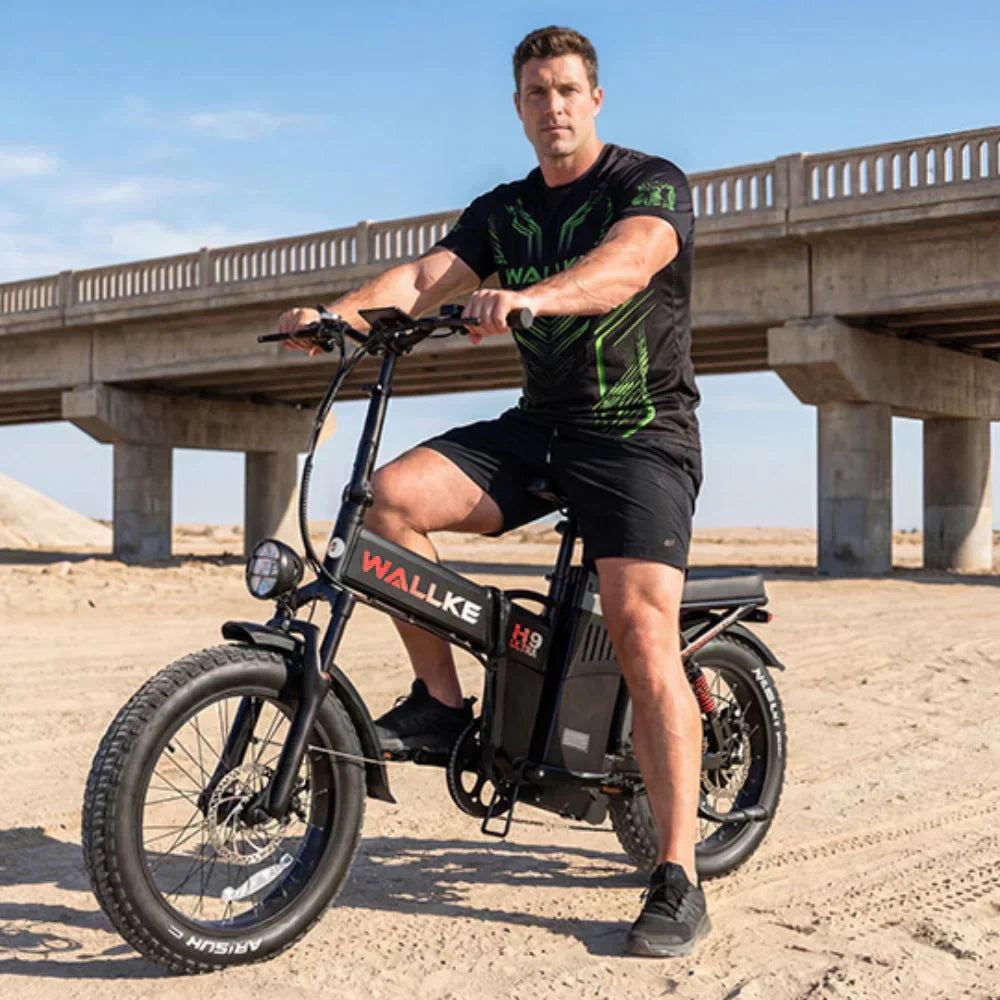
I want to share my honest feedback regarding the comparison between single motor and dual motor Wallke models.
After real-world riding experience in Los Angeles — a city with constant hills and elevation changes — it is very clear that the dual motor Wallke H9 AWD performs significantly better than any single motor version.
A single motor setup may work on flat terrain, but in hilly environments:
The motor operates under constant heavy load
Internal planetary gears are placed under excessive stress
Gear wear accelerates noticeably on steep climbs
Torque delivery feels weak under sustained uphill riding
Overall power output is insufficient for demanding terrain
In contrast, the dual motor (AWD) system distributes the workload between front and rear motors:
Significantly higher combined torque
Strong and stable hill-climbing performance
Reduced strain on each individual motor
Better traction and control
More consistent power under load
In real-world hill conditions, nothing compares to the torque and pulling power of a dual motor setup.
While dual motor systems may slightly impact battery range due to higher power draw, the performance advantage far outweighs that tradeoff. For cities like Los Angeles, dual motor is not just better — it is the correct engineering solution.
From a mechanical perspective, claiming that a single motor is superior for hilly terrain does not reflect actual field performance. Based on practical use, the dual motor H9 AWD is clearly more powerful, more reliable under load, and better suited for demanding environments.
I strongly recommend positioning the dual motor system as the optimal choice for riders in mountainous or hilly cities.
You already have a single motor option. If that was important I would but a single motor bike. The only reason I buy wallke over any other brand is that you have one of the best dual motors. Also, your premise that single motor is better ignores a lot of data and conditions. Single motor, even with more power, will never match dual under real world conditions. It is heavy and I wish I could change that, but not at the cost of my second motor. If you abandon dual motors I abandon wallke.
Will the new battery work the older h7 ?
Your argument for single motor ignores traction (AWD) and redundancy. With AWD, one motor fails, you can get home on the other.
Im 63,bad knees. 3kw battery , range is no problem..i have your 2024 H9 awd, single controller.. i have 7,000 km in 7 months.. only dislike, no torque up hill.. steep street roads. Not safe going from 35 mph down to 11 mph. My next ebike will be a 72v (amps dont change, so wiring will be the same, more or less) i am hoping to get a larger diameter motor for torque..and speed of 45-50 mph max, torque hopefully of 400 n.m., Wired ebike is close but too fast, less torque.. i am hoping others are expressing my same thoughts, and maybe future you and ADD this style bike to your LINE of ebikes.. your frames are very strong to handle a 72v high torque drive system and fit a 40AH 72v in same compartment. I think many 60+ year people like myself have plenty of money to buy a ebike that can trailer the grandkids across the busy road, swiftly.