
A long range e-bike battery gives you freedom, but it also needs smarter charging, storage, and riding habits. This guide explains how to protect battery health, manage range on longer trips, and avoid common lithium-ion battery mistakes.

Quick answer: the 7 habits that matter most
For most riders, long range ebike battery care comes down to consistency. You do not need to obsess over every percent. You do need to avoid the habits that create the most stress on lithium-ion cells.
What “long range ebike battery care” really means
A long range electric bike usually has a larger battery pack than a basic city e-bike. That extra capacity helps with commuting, hills, heavier riders, cargo, weekend exploring, and fewer charging stops. But a larger battery is still a lithium-ion battery. It ages with use, temperature, charge cycles, and storage habits.
Good battery care does three things:
- Protects capacity so the bike keeps more of its real-world range over time.
- Protects safety by reducing risky charging, storage, and replacement habits.
- Protects ride planning so you are less likely to run out of power on a commute or long trip.
E-bike battery charging tips for daily riders
Charging is where many battery problems begin. The goal is simple: charge with the right equipment, in the right place, for the right amount of time.
1. Use the manufacturer-approved charger
Do not choose a charger only because the plug fits. Voltage, current, connector design, communication pins, and the battery management system need to match. A charger that is too aggressive or incompatible can shorten battery life and may create a fire risk.
For Wallke owners, use the charger listed for your specific model and battery size. If you are replacing a charger, confirm exact voltage, current, connector, and model compatibility before buying from a third-party marketplace; do not use a charger just because it physically plugs in.
2. Charge at room temperature when possible
Lithium-ion batteries do not like extremes. After a hot summer ride or a steep hill climb, let the battery cool before charging. After a cold winter ride, let the battery warm up indoors before charging. Charging a very cold, hot, or damaged battery is harder on the cells.
3. Do not make overnight charging your routine
Modern e-bike chargers and battery management systems are designed to stop or reduce charging when the battery is full, but that does not make unattended charging a good habit. Charge while you are awake and nearby. Unplug the charger when the battery is done.
4. Charge on a safe surface
Charge away from beds, couches, curtains, paper, gasoline, heaters, direct sunlight, and blocked exits. Plug directly into a wall outlet when your local safety guidance and manufacturer instructions recommend it. Avoid daisy-chained extension cords and overloaded power strips.
5. Avoid riding to 0% whenever you can
Occasionally coming home low is normal. Making deep discharge a daily habit is different. If your commute normally drains the battery near empty, your battery may be too small for the route, the tire pressure may be low, or the assist level may be too high for daily efficiency.
Should you follow the 20/80 rule?
The 20/80 rule means keeping your e-bike battery roughly between 20% and 80% during normal use. It is popular because lithium-ion cells usually experience less stress when they are not constantly held at the very top or bottom of their charge range.
But treat it as a practical habit, not a religion.
Use 80% for daily rides
If your normal commute, errands, or short trail ride only uses part of the battery, stopping around 80% can be a reasonable way to reduce long-term stress.
Use 100% when you need full range
Before a long ride, hilly route, heavy cargo day, or cold-weather commute, charge fully. Just try not to leave the battery sitting full for many days afterward.
For many riders, the easiest routine is: charge to full before long rides, charge only as much as needed for short daily rides, and avoid storing the battery full or empty.
How long does an ebike battery take to charge?
Charging time depends on battery capacity, charger output, battery temperature, the battery’s starting charge level, and the final balancing stage near full. Bigger long-range batteries naturally take longer.
A rough way to understand charging time is:
Here are examples based on Wallke product specifications provided for this article:

| Model | Battery capacity | Listed charger / charge time | Care note |
|---|---|---|---|
| Wallke H7 AWD | 48V/60Ah, 2880Wh AWD / dual-motor step-thru setup |
Use the charger supplied for the H7 AWD 60Ah battery configuration. Check the current product page or owner manual for the exact charger label and charge-time details. | Do not mix chargers across models or battery configurations, even when connectors look similar. |
| Wallke H7 Ultra | Three Ultra configurations: 55Ah storage battery, dual-drive, 1000W×2 55Ah storage battery, single-drive, 2000W 40Ah standard battery, single-drive, 2000W One-piece aluminum frame |
Dedicated charging cable; listed charge time 8-10 hours | Only the 55Ah storage-battery versions should be described as outdoor-power / power-storage versions. The 40Ah version is a standard battery-frame version. |
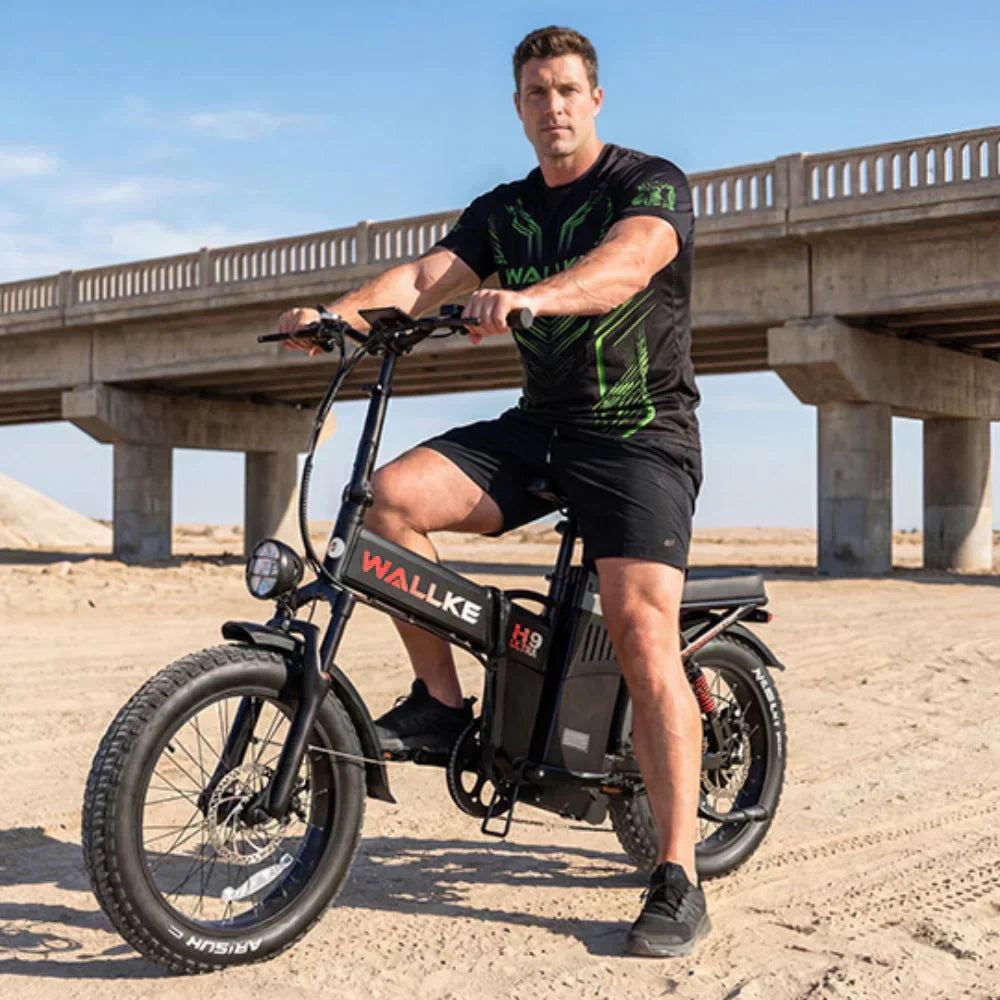
| Wallke H9 AWD | 48V/40Ah (1920Wh) or 48V/60Ah (2880Wh) AWD / dual-motor folding setup |
40Ah: 48V 6A fast charger 60Ah: 48V 10A smart fast charger Listed charge time: 6-8 hours |
Match the charger to the exact 40Ah or 60Ah battery configuration. Do not interchange them. |
| Wallke H9 Ultra | Three Ultra configurations: 55Ah storage battery, dual-drive, 1000W×2 55Ah storage battery, single-drive, 2000W 40Ah standard battery, single-drive, 2000W Folding aluminum frame |
Dedicated charging cable; listed charge time 8-10 hours | H9 Ultra shares the same three Ultra battery/drive configurations as H7 Ultra; the key difference is the folding frame. Listed range is up to 80-100 miles depending on rider weight, terrain, assist level, throttle use, payload, temperature, and riding conditions. |
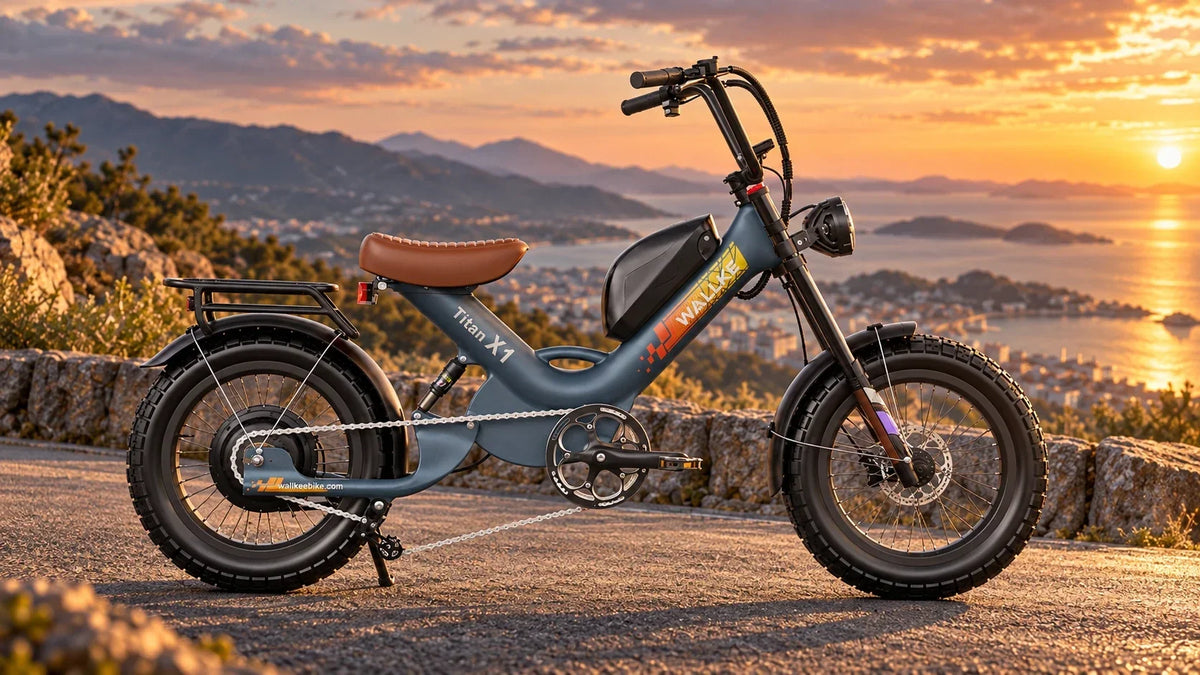
| Wallke Titan X1 | 48V/30Ah, 1440Wh | 48V 3A charger; listed charge time 7-8 hours | Listed range is up to 40 miles throttle / up to 50 miles PAS, depending on rider weight, terrain, assist level, throttle use, tire pressure, payload, and weather. |
Specifications can change by production batch, region, battery option, and product update. Always confirm the charger and battery details on the current product page or owner manual before ordering replacement parts.
How to store an ebike battery for winter or long breaks
Storage matters because lithium-ion batteries continue to age even when you are not riding. Poor storage can also turn a healthy battery into a weak one before the next riding season.
Choose a dry, moderate place
Store indoors or in a dry protected space. Avoid freezing garages, hot sheds, direct sun, heaters, and damp areas.
Do not store at 0% or 100%
For longer storage, keep the battery at a middle charge level. Check it periodically and top up only if needed.
Keep exits clear
Do not store or charge a battery where it could block a door, hallway, bedroom exit, or fire escape route.
How to increase range on a long range electric bike
When riders ask “How do I increase range of electric bike?”, they often focus only on battery size. Battery size matters, but real-world range is also shaped by how the bike is ridden and maintained.

| Range factor | What happens | What to do |
|---|---|---|
| Tire pressure | Low pressure increases rolling resistance, especially on fat tires. | Check pressure before longer rides and follow the tire sidewall / bike manual range. |
| Assist level | Higher PAS levels use more energy. | Use lower assist on flats and save high assist for hills, traffic starts, and headwinds. |
| Throttle use | Heavy throttle drains a battery faster than steady pedal assist. | Use throttle briefly instead of holding it open for long stretches. |
| Payload | Rider weight, cargo, bags, and child seats all require more energy. | Pack lighter when range is important and balance cargo securely. |
| Terrain | Hills, soft sand, snow, gravel, and mud increase motor load. | Plan routes with realistic battery reserve instead of assuming flat-road range. |
| Brake drag and drivetrain | Rubbing brakes and dirty drivetrains waste energy. | Keep brakes adjusted, chain clean, and wheels spinning freely. |
| Temperature | Cold weather can reduce available range during the ride. | Store the battery indoors before winter rides and plan extra reserve. |
Choosing a long-range Wallke setup without overworking the battery
The best battery care starts before the ride: choose a bike with enough battery for how you actually ride. If your daily route always drains the pack to the bottom, you may need a larger battery configuration or a more efficient riding routine.
For browsing by use case, compare all Wallke e-bikes, dual motor e-bikes, fat tire e-bikes, commuter e-bikes, folding e-bikes, and off-road e-bikes.
Battery warning signs you should not ignore
Stop using or charging the battery and contact the manufacturer, dealer, or qualified service provider if you notice any of these signs:
- Swelling, bulging, cracking, punctures, or a damaged battery case.
- Liquid leakage, burning smell, chemical smell, smoke, hissing, or popping sounds.
- Battery becomes unusually hot while riding, charging, or sitting unused.
- Charger or connector becomes hot, melted, discolored, loose, or noisy.
- Sudden shutdowns, rapid voltage drop, or a major range loss that appears suddenly.
- Battery was dropped, crushed, submerged, or involved in a crash.
Do not try to open, disassemble, rebuild, modify, or re-cell a battery pack at home. Do not use random used cells or modified packs. A damaged lithium-ion battery can become dangerous even when it is not actively charging.
Common ebike battery care mistakes
Mistake 1: Treating every ride like a range test
It is fine to test range occasionally. But if you regularly drain the battery to the lowest level, you add unnecessary stress. Keep a reserve, especially in cold weather or on hilly routes.
Mistake 2: Buying the cheapest replacement charger
A low-cost charger can be expensive if it damages the battery. Match voltage, current, connector type, and manufacturer recommendations. When in doubt, use the official replacement charger.
Mistake 3: Storing the bike in heat
Heat accelerates battery aging. A battery left in direct sun, a hot car, or an unventilated shed can lose health faster than one stored in a cool, dry space.
Mistake 4: Spraying products into electrical areas
Can you use WD-40 on an ebike? For the chain or mechanical parts, use products designed for bicycles and follow the label. For battery ports, connectors, controller areas, displays, and charging ports, do not spray oils, degreasers, or solvents. Keep electrical areas dry and clean.
Mistake 5: Ignoring tire pressure and brake rub
Many “battery problems” are actually efficiency problems. A rubbing brake rotor, underinflated fat tire, or heavy cargo setup can make a good battery feel weak.
Simple battery care schedule
| When | What to check | Why it matters |
|---|---|---|
| Before every long ride | Charge level, tire pressure, brake rub, route distance, weather, payload. | Prevents surprise range loss and avoids deep discharge. |
| After a wet or rough ride | Battery case, ports, mount, connectors, unusual heat, impact damage. | Finds damage before the next charge cycle. |
| Every month | Charging behavior, range trend, charger cable, connector fit, software/display errors. | Small problems are easier to fix early. |
| Before storage | Clean and dry battery, mid-level charge, safe storage location. | Reduces aging during long breaks. |
| After storage | Case condition, charge level, charger behavior, first short test ride. | Confirms the battery is behaving normally before a long ride. |
FAQ: long range ebike battery care
How do I make a long range ebike battery last longer?
Use the charger recommended by the manufacturer, avoid regularly draining the battery to empty, avoid storing it at 100% for long periods, charge and store it at moderate room temperatures, keep the battery dry, and inspect it after hard impacts or drops.
Should I always keep my ebike battery fully charged?
No. A full charge is useful before a long ride, but for day-to-day use and storage, it is usually better not to leave a lithium-ion battery sitting at 100% for long periods. For storage, keep it around a mid-level charge and follow your owner manual.
What is the 20/80 rule for an ebike battery?
The 20/80 rule means trying to keep the battery between about 20% and 80% during normal daily use. It is not a strict law. Short daily rides can avoid long periods at full charge, long rides can use 100%, and storage should avoid both long-term 100% and repeated deep discharge to 0%.
How long does an ebike battery take to charge?
It depends on battery capacity, charger output, battery temperature, starting charge level, and the final balancing stage. If capacity is listed in Ah, divide Ah by charger amps for a rough estimate. If it is listed in Wh, divide Wh by approximate charger watts. Real charging usually takes longer near full, and Wallke charge times vary by model and battery configuration.
Do H7 Ultra and H9 Ultra have the same battery and drive versions?
Yes. Based on the updated product parameters used for this article, H7 Ultra and H9 Ultra share three Ultra configurations: a dual-drive 55Ah storage-battery version with 1000W×2 motors, a single-drive 55Ah storage-battery version with a 2000W motor, and a single-drive 40Ah standard-battery version with a 2000W motor. The key difference is frame structure: H7 Ultra is a one-piece frame, while H9 Ultra is a folding frame.
Are all H7 Ultra and H9 Ultra versions outdoor power or power-storage versions?
No. Only the 55Ah storage-battery versions should be described as outdoor-power or power-storage versions. The 40Ah version is a standard battery-frame version and should not be marketed as an outdoor power-storage battery.
Can I use a faster charger on my ebike battery?
Only use a charger that is supplied or recommended by the manufacturer for your exact battery system. A charger with the wrong voltage, current, or connector can damage the battery and create a serious safety risk.
Can I use WD-40 on an ebike battery or connectors?
Do not spray WD-40, oil, degreaser, or solvents into the battery port, charger port, display, controller, or electrical connectors. Use a dry cloth and follow the manufacturer’s cleaning instructions. If connectors look corroded or damaged, contact support before riding or charging.
How should I store an ebike battery for winter?
Store it indoors or in a dry, moderate-temperature space, away from direct sun, heaters, exits, and flammable materials. Leave it at a mid-level charge rather than empty or full, and check it periodically according to your manual.
Why is my ebike battery losing range after a year?
Some capacity loss is normal as lithium-ion batteries age. Faster range loss can come from frequent deep discharge, heat, cold charging, heavy throttle use, low tire pressure, high payload, hills, brake drag, or a damaged/imbalanced pack.
Is it safe to charge an ebike battery overnight?
Avoid charging while sleeping, away from home, or otherwise unable to monitor the battery. Charge on a safe surface, unplug it when charging is complete, and follow the manufacturer’s instructions.
When should I replace an ebike battery?
Replace or service the battery if it has swelling, a damaged case, punctures, liquid leakage, burning smells, unusual noises, overheating, sudden shutdowns, or a major range drop that cannot be explained by weather, tire pressure, load, or riding style.
Ready for longer rides with smarter battery planning?
Battery care helps you get more useful life from the pack you already own. If your current e-bike still cannot cover your commute, cargo load, hills, or weekend rides without running low, compare Wallke long-range models and choose the battery and drive configuration that matches your real route.


Leave a comment