
An electric bike’s weight limit affects more than the frame. As total load rises, the brakes, wheels, tires, suspension, and battery system all work harder. Before buying, confirm what the published capacity includes and how close your normal riding setup would be to that limit.

Quick Answer: How Much Weight Can an Electric Bike Hold?
Many general-use electric bikes have weight limits around 250 to 300 lb, while some heavy-duty, fat-tire, and cargo e-bikes are rated for 350 to 400 lb or more. However, an electric bike weight limit normally means the bike’s total payload, not just the rider’s body weight.
Total payload usually includes the rider, clothing, locks, accessories, bags, and cargo carried on the bike. For example, a 300-pound rider needs more than a 300-pound payload rating once normal riding gear is added. A 400-pound rider generally needs a bike rated above 400 pounds.
Published capacities vary by model and manufacturer, so always use the official weight capacity for the exact e-bike and configuration you are considering.
Do E-Bikes Have a Weight Limit?
Yes. E-bikes have a manufacturer-specified weight limit, usually listed as maximum payload, maximum load, or weight capacity. The limit normally includes the rider plus clothing, locks, accessories, bags, and cargo carried on the bike. It is different from the weight of the e-bike itself.
Going above the published limit can increase stress on the wheels, tires, brakes, suspension, and frame. It can also affect handling, climbing performance, and battery range. Because weight limits vary substantially between models, always check the specifications for the exact e-bike rather than assuming that all commuter, fat-tire, folding, or cargo e-bikes have the same capacity.
What Is the Weight Limit for an Electric Bike?
The electric bike weight limit is the maximum payload the manufacturer permits the bike to carry under its stated conditions of use. It may also appear in the specifications as maximum payload, maximum load, or electric bike weight capacity.
That number usually includes:
- The rider
- Clothing, shoes, and riding gear
- A helmet, backpack, water, and personal items
- Locks, mirrors, baskets, bags, and other accessories
- Rear-rack or front-rack cargo
- A child seat or passenger, only when the bike and rack are specifically designed for that use

The bike’s own weight is generally not added to the payload calculation unless the manufacturer specifically defines the rating differently. The installed battery is also normally part of the bike’s own weight rather than payload. Always check the product manual or official specification page because terminology is not standardized across every brand.
Electric Bike Weight Capacity vs. E-Bike Weight

Electric bike weight capacity describes how much rider and cargo the bike can carry. E-bike weight describes how much the bicycle itself weighs. They are two different measurements and should not be used interchangeably.
| Term | What it means | Why it matters |
|---|---|---|
| E-bike weight | The weight of the bicycle itself, usually including its battery. | Affects lifting, storage, transport, rack compatibility, and low-speed handling. |
| Maximum payload | The total rider-and-cargo load the bike is rated to support. | Affects rider fit, safety margin, braking, wheel stress, and durability. |
| Rear-rack capacity | The maximum load allowed on the rear rack alone. | May be much lower than the bike’s total payload limit. |
| Gross vehicle weight | Bike weight plus total payload, when a manufacturer publishes this figure. | Useful for trailers, carriers, elevators, and transport equipment. |
A heavy e-bike does not automatically have a high payload rating. A lighter bike is not automatically weak. Capacity depends on the complete system and the manufacturer’s testing criteria.
How Much Weight Can an Electric Bike Hold?
There is no universal number. Published capacities vary widely. The ranges below are broad shopping examples, not industry standards or guarantees; the official rating for a specific model always takes priority.
| General e-bike type | Illustrative shopping range | Typical use | What to verify |
|---|---|---|---|
| Light commuter or folding e-bike | About 220–300 lb | Urban riding and lighter cargo | Wheel strength, hinge design, rack rating |
| Standard all-purpose e-bike | About 250–330 lb | Recreation and commuting | Brakes, spoke tension, tire load rating |
| Heavy-duty or fat-tire e-bike | About 300–400 lb | Heavier riders, rougher roads, more equipment | Frame, rims, suspension, brake hardware |
| Cargo e-bike | About 350–500+ lb | Freight, groceries, passengers on approved setups | Total capacity versus rack and passenger limits |
These are broad shopping ranges, not engineering guarantees. A model advertised at 400 pounds should still be checked for its rear-rack limit, recommended rider height, intended terrain, tire pressure requirements, and passenger-use rules.
E-Bike Weight Limits for 300-, 350-, and 400-Pound Riders

For a 300-pound rider
A 300-pound person can ride an electric bike when the bike’s official payload rating covers the rider plus all clothing, accessories, and cargo. Clothing, water, a lock, tools, and bags can add meaningful weight, so a 300-pound-rated bike may already be too close to the limit.
A 350- or 400-pound rating leaves more capacity for gear than a 300-pound rating. It does not, by itself, guarantee better fit, braking, wheel durability, or ride quality.
For a 350-pound rider
A bike rated for exactly 350 pounds would leave no capacity for normal clothing, water, locks, accessories, or cargo when the rider alone weighs 350 pounds. Compare models rated above the complete riding load and verify the current manufacturer specifications.
For a 400-pound rider
A 400-pound rider needs a model explicitly rated above the complete riding load. A bike with a 400-pound maximum payload leaves no capacity for clothing, accessories, water, or cargo when the rider alone weighs 400 pounds.
Do not rely on forum claims that a frame can “probably hold more.” The weakest component may be a wheel, spoke, tire, rack, hinge, seatpost, or brake system rather than the main frame.
What Happens If You Exceed an E-Bike’s Weight Limit?

Exceeding the published capacity does not guarantee an immediate failure. It does increase stress and can reduce the margin the bike was designed to provide.
Longer stopping distance
A heavier total load increases the energy that the brakes must dissipate and the traction that the tires must maintain, especially on descents or wet surfaces.
Higher wheel stress
Spokes, rims, hubs, and tires absorb repeated impacts. Loose spokes and damaged rims may become more likely.
Reduced range
A heavier total load usually requires more energy during acceleration, climbing, and stop-and-go riding.
Slower climbing
Extra load increases demand on the motor and battery during sustained climbs and may reduce climbing speed or range.
More suspension sag
Suspension can sit deeper in its travel, bottom out sooner, or feel less controlled when not adjusted for the load.
Possible warranty issues
Overload-related damage may be excluded under some warranty terms. Review the warranty for the exact model before purchase.
How Rider Weight Affects Range
Rider weight affects range, but it is only one variable. Speed, throttle use, hills, wind, temperature, tire pressure, road surface, stop frequency, battery condition, and assist level can be equally important.
Extra weight usually has the greatest effect when:
- Climbing long or steep hills
- Accelerating repeatedly in urban traffic
- Using throttle heavily
- Riding with low tire pressure
- Traveling on sand, mud, grass, or loose gravel
- Carrying cargo that increases aerodynamic drag
Published range figures should be treated as test-condition estimates, not guaranteed mileage. For a deeper explanation, read Wallke’s guide to the longest-range e-bike factors and its long-range e-bike battery care guide.
How to Choose an E-Bike for a Heavier Rider
Treat the published capacity as the first screening number. Then check rider fit, wheel construction, braking, tire limits, cargo placement, and the bike’s intended use.

1. Calculate your actual riding load
Add your body weight, normal clothing, helmet, water, locks, bags, tools, and expected cargo. Use your realistic maximum, not your lightest possible setup.
2. Leave capacity for real life
A rider who weighs 285 pounds and regularly carries 25 pounds of gear already creates a 310-pound payload. A 300-pound-rated bike would be undersized for that use.
3. Check the wheels, not only the frame
Look for durable rims, appropriate spoke count or wheel construction, properly tensioned spokes, suitable tires, and clear tire-pressure guidance. Wheels often experience the most repeated impact stress.
4. Prioritize braking control
A properly sized and maintained hydraulic disc-brake system can offer strong, consistent control, but piston count or rotor size alone does not determine stopping performance. Pad condition, rotor condition, tire grip, setup, and maintenance also matter.
5. Match the motor to terrain
For flat commuting, moderate power may be sufficient. Heavier riders on steep grades may benefit from stronger low-speed torque, appropriate gearing, and a system designed to manage sustained climbing. A dual-motor e-bike can provide additional traction and drive force, but it also adds weight, energy use, and maintenance complexity.
6. Check frame access and rider fit
A step-through frame can make mounting and dismounting easier. A step-over frame uses a higher top tube and may suit riders who prefer a more traditional frame layout. Neither style should be assumed stronger without the manufacturer’s rating.
7. Confirm rack and passenger limits separately
A bike rated for 400 pounds may have a rear rack rated for far less. Never place a passenger on a rack unless the manufacturer explicitly approves the bike and rack for passenger use.
8. Consider the bike’s own weight
Many high-capacity e-bikes are also heavy, which can make them difficult to lift onto a hitch rack, carry upstairs, or move with the battery depleted. Verify the carrier’s per-bike capacity and include the battery unless you plan to remove it before transport.
Electric Bike Weight Limit in Pounds and Kilograms
| Pounds | Approx. kilograms | Shopping context |
|---|---|---|
| 250 lb | 113 kg | Common on lighter general-use bikes |
| 300 lb | 136 kg | Common general-purpose threshold |
| 330 lb | 150 kg | Frequently searched metric equivalent |
| 350 lb | 159 kg | More room for a heavier rider and light gear |
| 400 lb | 181 kg | Heavy-duty category; total payload must still be calculated |
| 500 lb | 227 kg | Usually specialized cargo or high-capacity designs |
Are Manufacturer Weight Limits Accurate?
A published limit is the best official number available, but brands may use different test methods and definitions. Some list total payload, some emphasize rider capacity, and others publish separate rack limits.
Do not intentionally exceed the published rating, even when another owner reports doing so without an immediate problem. Real-world durability also depends on potholes, curb impacts, speed, terrain, maintenance, tire pressure, and how cargo is distributed.
What to Look for in a 400-Pound-Capacity E-Bike
- An explicitly published 400-pound or higher maximum payload
- A frame size and rider-height range that fit you
- Wheels and tires suited to the load and intended terrain
- Strong, serviceable brakes with readily available pads
- A saddle and seatpost that remain stable under load
- Suspension that can be adjusted or selected for your weight
- A drivetrain matched to local hills and riding speed
- A separate rear-rack rating that covers your cargo
- Clear warranty, support, and replacement-parts information
Fat tires can improve comfort and traction, but tire width by itself does not establish payload capacity. Browse fat-tire e-bikes by verified specifications rather than assuming every wide-tire model is heavy-duty.
What About an Electric Bike With a 500-Pound Capacity?
A published 500-pound capacity is usually found on specialized cargo or high-capacity bikes rather than ordinary commuter models. Confirm whether the number means total payload, gross vehicle weight, or rider capacity. Also check the separate limits for the rear rack, passenger area, wheels, tires, and any cargo platform.
Wallke Models Currently Listed With a 400 lb Maximum Payload
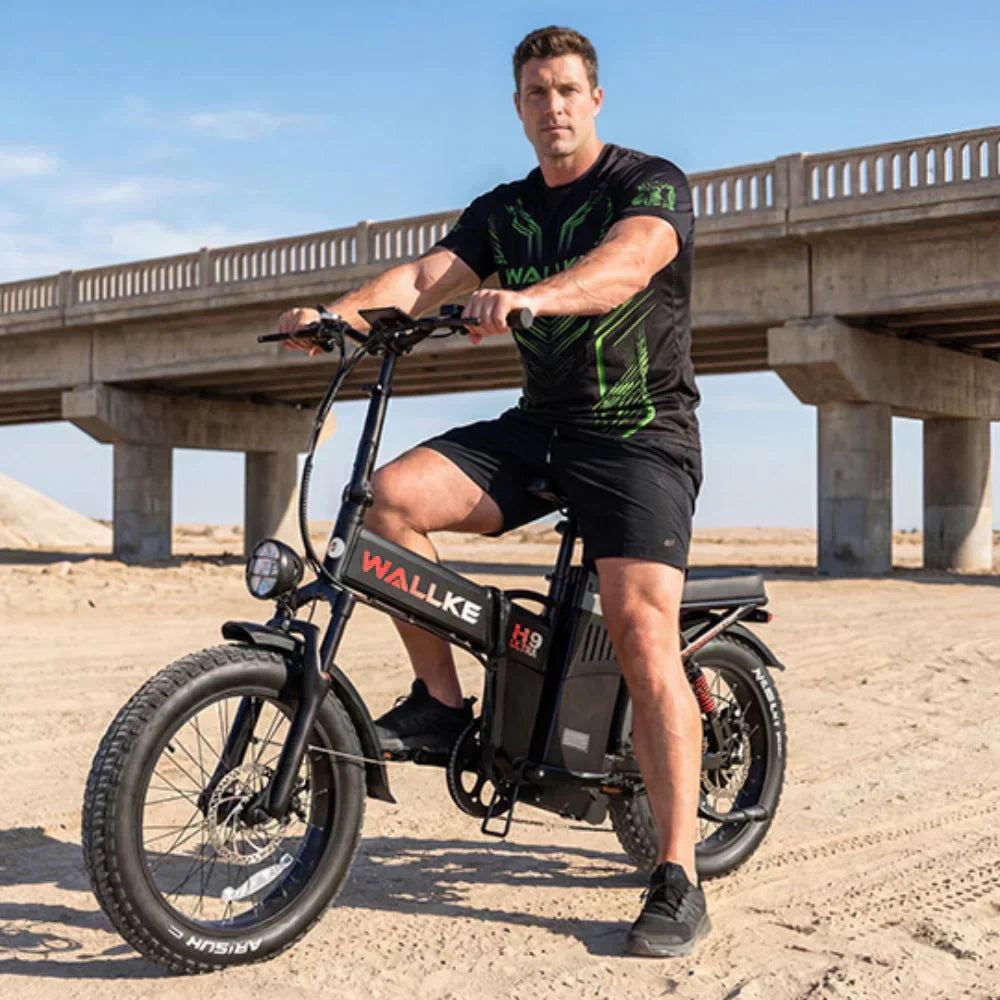
Several Wallke product specifications supplied for this guide list a maximum payload of 400 lb (181 kg), including the H7/H7 AWD, H9 AWD, H7 Ultra, and H9 Ultra configurations referenced below. This is a total maximum payload figure, so buyers still need to subtract clothing, equipment, accessories, and cargo from that capacity.

The models are not identical. H7-family bikes use a step-through frame format, while H9-family bikes use a step-over folding format. Motor, battery, wheel, range, and version details also vary. Check the current product page before ordering because specifications can change by model year and configuration.
- Wallke H7 / H7 AWD — step-through frame options
- Wallke H9 AWD — step-over folding frame
- Wallke H7 Ultra — step-through frame
- Wallke H9 Ultra — step-over folding frame
For a broader feature discussion, see the guide to choosing the best e-bike for heavy riders.
Pre-Ride Checks Matter More Near the Upper Limit
Any rider should inspect an e-bike regularly. When the total payload is close to the maximum, routine checks become even more important.
- Set tire pressure within the tire and manufacturer limits
- Check spokes for looseness or unusual sounds
- Inspect rims and tires for cracks, cuts, or deformation
- Test both brakes before entering traffic or descending
- Confirm the seatpost is inserted beyond its minimum-insertion mark
- Tighten rack and accessory hardware to the specified torque
- Distribute cargo low, centered, and evenly when possible
- Arrange an inspection after a hard impact or when the bike develops persistent wobbling, brake changes, unusual noises, or altered handling
Final Takeaway
Add your rider weight, normal gear, accessories, and expected cargo before comparing models. The result must remain within the bike’s published payload rating and any separate rack or passenger limit.
A 400-pound rating does not mean the bike is suitable for a 400-pound rider carrying additional gear. When specifications are unclear, ask the manufacturer before buying rather than guessing.
Frequently Asked Questions
What is the average electric bike weight limit?
Many general-use e-bikes are rated around 250 to 300 pounds. Heavy-duty, fat-tire, and cargo models may be rated for 350 to 400 pounds or more. The official rating for the exact model and configuration is the number that matters.
Does an e-bike weight limit include the bike itself?
Maximum payload usually refers to the rider and everything carried by the bike, not the bike’s own weight. Some manufacturers define ratings differently, so check the manual or specification page.
Can a 300-pound person ride an electric bike?
Yes, when the bike is rated for the rider’s complete payload. Because clothing, locks, water, accessories, and cargo add weight, a 350- or 400-pound rating may be more appropriate than a 300-pound limit.
What e-bike can hold 400 pounds?
Choose a model whose official specifications explicitly state a 400-pound or higher maximum payload. Wallke product specifications supplied for the H7/H7 AWD, H9 AWD, H7 Ultra, and H9 Ultra configurations list a 400-pound maximum payload, but buyers must verify the current model page and include all clothing, accessories, and cargo in the calculation.
Can a 400-pound person ride a bike rated for 400 pounds?
That would leave no capacity for clothing, accessories, water, or cargo. A rider who weighs 400 pounds should look for a bike rated above the complete riding load.
Does rider weight reduce e-bike range?
Usually, yes. More total mass requires more energy during acceleration and climbing. The actual effect also depends on speed, hills, wind, tire pressure, temperature, assist level, and throttle use.
Is a 150 kg e-bike weight limit enough for a heavy rider?
A 150 kg limit is about 330 pounds. Subtract the weight of clothing, accessories, and cargo to determine the maximum suitable rider weight. It may be insufficient for a 330-pound rider once gear is included.
Can I upgrade an e-bike to increase its weight capacity?
Stronger wheels, tires, brakes, or suspension may improve component performance, but they do not officially raise the manufacturer’s frame or total payload rating. Only the manufacturer can establish a revised certified or published capacity.
Does a rear rack’s load count toward the total payload?
Yes. Rack cargo normally counts toward the bike’s total payload and must also remain below the rack’s separate maximum load.
Can a heavy e-bike go on a hitch rack?
Only when the rack’s per-bike capacity, total capacity, wheelbase, tire width, and attachment system support that exact bike. Include the battery in the weight unless it will be removed before transport.
Is a 350-pound e-bike weight limit enough for a 300-pound rider?
It may be, but only after adding clothing, water, locks, accessories, and cargo. A 300-pound rider with normal gear can approach a 350-pound limit quickly, so calculate the complete riding load before choosing.
Does the installed e-bike battery count toward payload?
The installed battery is normally part of the bike’s own weight, not its payload. Definitions can vary, so the official manual or product specifications for the exact model should control.
Editorial note: Capacity figures and product configurations should be verified on the current manufacturer page before purchase. General capacity ranges in this article are shopping guidance, not substitutes for a model’s official specifications or professional mechanical advice.


Leave a comment