
Quick Answer: What Makes a Good Adventure Ebike?
A good adventure ebike is built for longer, more varied rides than a basic city e-bike. It should feel stable on pavement, gravel, packed dirt, campground roads, and rolling hills while carrying the rider, water, tools, and light cargo with confidence.
1. Range you can trust
Look for a battery large enough for your real route, not just the best-case range number. Hills, throttle use, cold weather, soft ground, and heavier loads reduce range.
2. Stable tires and suspension
Wider tires, all-terrain tread, and front or full suspension can make rough roads and loose surfaces feel more controlled.
3. Brakes and frame strength
Hydraulic disc brakes, strong rotors, a reinforced frame, and a clear payload rating matter more than flashy styling.
For most riders, the best adventure ebike is not the most extreme model. It is the bike that matches your terrain, distance, body size, storage needs, and local riding rules.
What Is an Adventure Ebike?
An adventure ebike is an electric bicycle designed for riders who want one bike for daily utility and weekend exploration. It sits between a commuter e-bike and a dedicated off-road machine.
In everyday terms, an electric adventure bike is usually built for:
- Longer recreational rides beyond short neighborhood trips.
- Mixed surfaces such as pavement, gravel, park roads, dirt paths, and campground routes.
- More climbing support than a basic lightweight city bike.
- Better comfort over bumps, cracks, and uneven ground.
- Carrying essentials like a backpack, rear rack bag, lock, repair kit, water, or light camping gear.
Who Is This Type of E-Bike Best For?
You should consider this type of e-bike if your riding plans go beyond smooth bike lanes. It is especially useful if you want a single e-bike that can handle commuting during the week and longer outdoor routes on weekends.
Good fit
- You ride longer routes and dislike range anxiety.
- You want more stability on gravel, sand, dirt roads, or broken pavement.
- You carry cargo, tools, groceries, or outdoor gear.
- You want stronger hill support than a basic commuter e-bike.
- You prefer an upright, confident ride feel.
May not be the best fit
- You only ride short city trips on flat pavement.
- You need the lightest possible bike for stairs or apartment storage.
- You want a narrow road-style e-bike for speed and efficiency.
- You plan to ride technical mountain bike trails where local rules require specific bike classes.
Best Adventure Ebike by Use Case
The best adventure ebike is not the same for every rider. A bike that feels perfect for gravel weekends may be too heavy for apartment stairs, while a compact folding model may not be the best choice for very steep, loose climbs. Use your main ride style first, then compare the specs that support it.
Best for long weekend rides
Prioritize battery capacity, comfort, hydraulic brakes, lighting, rack compatibility, and a riding position that stays comfortable after the first hour.
Best for gravel and mixed terrain
Look for wider all-terrain tires, stable geometry, front or full suspension, and predictable braking on loose surfaces.
Best for short riders
Compare standover height, seat height, reach, handlebar position, and step-through frame options. A lower, easier-to-mount frame can improve control when carrying gear.
Best for heavy riders or cargo
Check the total payload rating, frame strength, braking system, tire volume, wheel construction, and whether the motor setup has enough usable torque for hills.
Best for camping and hunting utility
Focus on range, quiet operation, cargo setup, tire traction, lighting, repairability, and whether local land rules allow e-bike access on your planned route.
Best for RV travel or compact storage
Consider a folding e-bike if storage and transport matter, but still compare weight, folded size, frame stiffness, brakes, and battery capacity.
Key Specs That Actually Matter for Adventure Riding
A strong spec sheet should help you understand how the bike will behave in real life. When comparing adventure ebikes, focus on range, motor behavior, braking, tires, frame, fit, and support.
On mobile, scroll sideways to compare the full table.
| Spec | What to look for | Why it matters for adventure rides |
|---|---|---|
| Battery capacity | Higher Wh or Ah capacity, quality cells, clear charging guidance | Longer routes, hills, throttle use, cargo, and cold weather can all reduce range. |
| Motor and torque | Enough climbing support for your terrain; dual motor only if you need extra traction | Steep hills, loose surfaces, and heavy loads require more usable torque than flat city riding. |
| Adventure bike tires | All-terrain tread, puncture resistance, 4-inch or wider fat tires for soft surfaces | Tires affect comfort, traction, braking feel, and confidence on gravel or dirt. |
| Brakes | Hydraulic disc brakes; larger rotors are useful on heavier bikes | Adventure routes often include descents, cargo, speed changes, and wet surfaces. |
| Suspension | Front suspension for light mixed terrain; full suspension for rougher routes | Suspension reduces fatigue and helps keep the tires planted over uneven ground. |
| Payload rating | Clear max payload and rear rack rating | The bike should support rider weight plus bags, tools, and supplies. |
| Frame and fit | Step-through, folding, or high-step design based on rider height and storage needs | A bike that fits well is safer, easier to control, and more comfortable on longer rides. |
| Lighting and accessories | Bright front light, brake light, fenders, rack compatibility, USB or display features | Useful for early starts, late returns, commuting, and changing weather. |
Motor, Torque, and Dual-Motor Traction
A flat city commute does not require the same motor setup as a steep gravel road. For hills, cargo, and loose surfaces, torque matters because it affects how strongly the bike can pull from lower speeds.
A dual-motor setup can be useful when you need extra traction on hills, soft dirt, snow, sand, or uneven surfaces. It is not necessary for every rider, but it can make sense for heavier riders, steep terrain, and riders who frequently carry gear.
If traction is your main concern, you can compare dual-motor options for rougher routes.
Fat Tires and Mixed-Terrain Control
Many adventure ebikes use fat tires because wider tires can add stability and comfort. A fat tire adventure ebike can feel more planted on gravel, sand, snow, and rough pavement. The tradeoff is that fat tires can add weight and rolling resistance compared with narrow city tires.
If your routes are mostly paved, you may not need the most aggressive tread. If your routes include loose dirt, park roads, or beach-style surfaces, models with wider tires for loose surfaces are usually a better match.
Brakes, Rotors, and Safety Control
Adventure-style e-bikes are often heavier than minimalist city bikes. They may also carry cargo or ride on steeper routes. That makes braking quality important.
- Hydraulic disc brakes are generally easier to modulate than basic mechanical brakes.
- Larger rotors can help with heat management and stopping control on heavier bikes.
- Brake cut-off features can add control by stopping motor power during braking.
- Check pads, rotors, and tire pressure before longer rides.
Real-World Range: Why Adventure Rides Use More Battery
Real-world range is usually lower than a maximum advertised range because adventure rides are less predictable than flat city routes. Climbing hills, riding into wind, using higher assist levels, carrying cargo, riding on soft ground, and starting in cold weather can all use more battery.
A practical rule is to choose more battery than your planned route appears to require. If your weekend route is 30 to 40 miles, look for enough battery margin so you can finish the ride without relying on the lowest assist mode or worrying about every hill on the way home.
How to Choose by Terrain and Ride Style
The right bike depends on where you will actually ride. Do not buy only for the most extreme scenario if 90% of your routes are paved. Match the bike to your normal use first, then add capability for the tougher rides you do most often.
Paved roads and city-to-trail routes
Choose a comfortable frame, reliable brakes, good lighting, fenders, and enough battery for round trips. A commuter-capable adventure setup can work well here.
Gravel and packed dirt
Look for wider tires, stable geometry, front suspension, and hydraulic brakes. Full suspension can be helpful if the surface is rough or washboarded.
Hills and heavy loads
Compare torque, battery capacity, motor setup, and payload rating. Extra traction may be worth considering for steep or loose climbs.
Camping, hunting, and outdoor utility
Prioritize range, tires, rack compatibility, lighting, and serviceable components. Quiet operation and cargo setup can matter more than top speed.
RV travel and compact storage
A folding electric adventure bike can make sense if you transport your bike by RV, truck, SUV, or need more compact storage at home.
Shorter riders and easier mounting
Shorter riders should compare standover height, seat height, reach, and handlebar position. A step-through frame can make starts, stops, and loaded rides easier to manage.
Adventure Ebike vs. Fat Tire, Off-Road, Commuter, Folding, and Dual Sport Options
Search results for “adventure ebike” often overlap with fat tire e-bikes, off-road e-bikes, commuter e-bikes, and even adventure bike motorcycle searches. Here is the practical difference.
On mobile, scroll sideways to compare the full table.
| Bike type | Best for | How it compares to an adventure ebike |
|---|---|---|
| Adventure ebike | Long rides, mixed terrain, weekend trips, utility | The balanced category: comfort, range, stability, cargo ability, and all-around capability. |
| Electric adventure bike | Same broad use case as adventure ebike | This is usually another way to describe an adventure-ready electric bicycle rather than a separate category. |
| Fat tire e-bike | Sand, snow, gravel, rough pavement, stability | Often a strong adventure choice, especially when traction and comfort matter. |
| Off-road ebike | Dirt roads, trails where permitted, rougher outdoor routes | More terrain-focused. Always check trail access rules before riding. |
| Commuter ebike | Daily pavement, bike lanes, errands, predictable routes | Usually lighter and more efficient, but may have less tire volume and rugged capability. |
| Folding ebike | Storage, RV travel, car transport, apartments | A folding model can be useful if you need capability plus compact storage. |
| Adventure bike motorcycle or dual sport | Motorized road and off-road touring | Not the same category. A motorcycle requires different licensing, protective gear, laws, and maintenance. |
Wallke Adventure-Ready Examples to Compare
The point of this guide is not that every rider needs the most powerful bike. The better question is which type of adventure setup fits your route. Wallke models are useful examples because the lineup includes long-range batteries, fat tires, full-suspension designs, dual-motor options, and folding or step-through formats.
Wallke H9 AWD
Dual motor Fat tire Long range
Built around dual 1000W hub motors, 20" x 4" all-terrain fat tires, full suspension, hydraulic disc brakes, and high-capacity battery options.
Best for: riders comparing adventure ebikes for steep hills, heavier loads, long routes, and extra traction on loose or uneven surfaces.
Not ideal for: riders who only need a lightweight city e-bike for short paved trips or who must carry the bike up stairs every day.
Wallke H7 / H7 AWD
Step-through AWD option Comfort fit
The H7 platform focuses on a step-through full-suspension frame, fat tires, hydraulic braking, and strong payload support.
Best for: riders who want adventure capability with easier mounting, a more accessible frame shape, and optional dual-motor traction.
Not ideal for: riders who prefer a traditional high-step frame or the narrowest, most efficient tire setup for pavement-only routes.
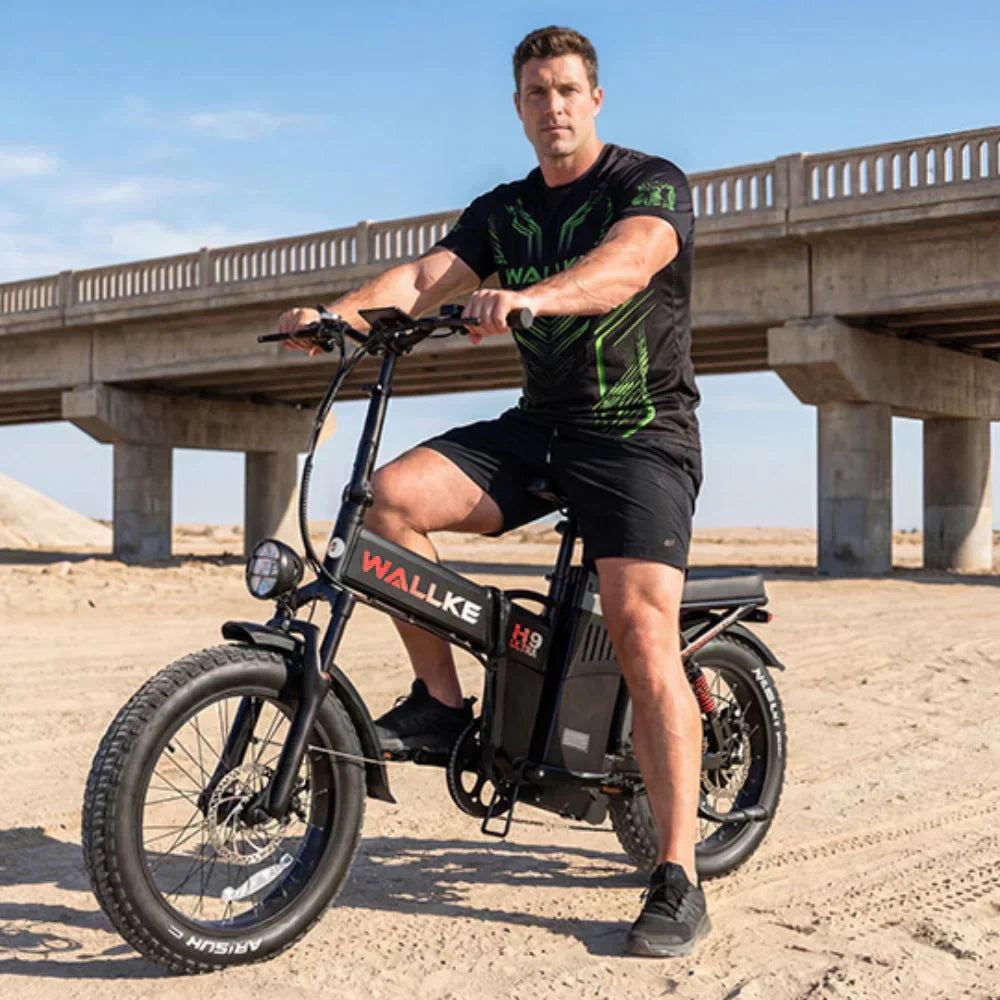
Wallke H9 Ultra
Folding Large battery Utility
Designed around a folding format, large-capacity battery system, 20" x 4" fat tires, torque-sensor riding feel, and four-piston hydraulic disc brakes.
Best for: riders who want long-distance adventure capability with easier storage, RV travel flexibility, or a more compact ownership setup.
Not ideal for: riders who do not need folding storage or who want the simplest, lightest possible e-bike for short daily errands.
To compare more options, start with the full Wallke e-bike lineup. If your main priority is traction, compare the dual-motor collection. If your main priority is stability on loose surfaces, compare models with wider tires for mixed terrain.
Trail Access, Laws, and Battery Safety
Adventure riding often crosses different land types: city streets, bike paths, parks, public lands, campgrounds, and private property. Rules can change by state, city, trail manager, and e-bike class.
- For state-level e-bike laws, check PeopleForBikes state-by-state e-bike laws.
- For National Park Service routes, check the NPS e-bike policy page and the specific park page before you ride.
- For Bureau of Land Management routes, check BLM e-bike guidance and local field office rules.
- For charging and battery safety, review the CPSC micromobility safety center.
Adventure Bike Gear Checklist
The right adventure bike gear depends on distance, weather, terrain, and how far you will be from help. For most mixed-terrain rides, start with safety, repair, hydration, and visibility.
Safety and comfort
- Properly fitted bicycle helmet.
- Gloves for grip and comfort.
- Eye protection for wind, dust, and bugs.
- Weather-appropriate layers.
- Front and rear lights for early or late rides.
Repair and route essentials
- Tire inflator or mini pump.
- Spare tube or patch kit.
- Compact multitool.
- Water and snacks.
- Phone, ID, lock, and basic first-aid items.
Final Buying Checklist Before You Choose
Before you choose an adventure ebike, answer these questions honestly:
Ride and terrain
- How many miles will you ride on a normal adventure day?
- Will the route include hills, gravel, sand, snow, or rough pavement?
- Do you need fat tires, full suspension, or dual-motor traction?
- Will you ride where e-bike class restrictions apply?
Fit and ownership
- Does the frame fit your height, inseam, and mounting preference?
- Is the payload rating enough for rider plus gear?
- Can you store, lift, transport, and charge the bike easily?
- Are replacement parts, warranty support, and accessories easy to find?
If you are comparing adventure bikes for sale, do not stop at price. A lower price can be attractive, but the real value is a bike that gives you range, control, safety, support, and confidence on the routes you actually ride.
Compare Wallke E-Bikes for Adventure-Style Riding
Compare Wallke electric bikes built for long range, fat tire stability, full-suspension comfort, folding utility, and dual-motor traction.
Compare All Wallke E-Bikes Compare Traction-Focused Models Compare Wider-Tire Models Compare Folding E-BikesFAQ: Adventure Ebikes
What is an adventure ebike?
An adventure ebike is an electric bicycle designed for longer rides and mixed terrain. It usually combines a larger battery, stable tires, comfort-focused geometry, stronger brakes, and cargo-friendly features for commuting, gravel, campground roads, and weekend exploration.
What is the best adventure ebike for most riders?
The best adventure ebike depends on your route. For mostly paved rides, choose comfort, range, lights, and rack support. For gravel, hills, or soft surfaces, prioritize wider tires, hydraulic brakes, suspension, and enough battery capacity. For steep or loose terrain, a dual-motor setup may be worth comparing.
What is the difference between an adventure ebike and an off-road ebike?
An adventure ebike is usually a broader all-around category for long rides, mixed terrain, commuting, utility, and weekend exploration. An off-road ebike is more focused on rough dirt roads, trails where permitted, and terrain-specific capability. Always check local access rules before riding off pavement.
What is the difference between an adventure ebike and a fat tire e-bike?
A fat tire e-bike describes the tire style, while an adventure ebike describes the use case. Many adventure ebikes use fat tires because wider tires can improve stability and comfort on gravel, sand, snow, and rough pavement, but not every fat tire e-bike is built for long-distance adventure riding.
How much range do I need for an adventure ebike?
Choose more range than your planned route requires. Hills, rider weight, cargo, wind, cold weather, soft terrain, and throttle use can reduce real-world range. For a 30- to 40-mile ride, it is smart to choose a bike with extra battery margin instead of relying on the maximum advertised range.
Are adventure ebikes allowed on trails?
It depends on the trail, state, land manager, and e-bike class. Some roads and trails allow e-bikes, while others restrict motorized or high-power models. Always check state rules, park rules, BLM or local land guidance, and posted signs before riding.
Is an adventure ebike the same as a dual sport or adventure motorcycle?
No. An adventure ebike is an electric bicycle with pedals and electric assist. A dual sport or adventure motorcycle is a motor vehicle category with different licensing, protective gear, maintenance, speed, and access rules.
What should short riders look for in an adventure ebike?
Shorter riders should compare standover height, reach, handlebar position, seat adjustment, and frame style. A step-through adventure ebike can be easier to mount and control, especially with cargo or on uneven ground.
Do I need a dual motor adventure ebike?
You do not need dual motors for every adventure ride. A dual-motor setup makes more sense if you regularly ride steep hills, loose surfaces, heavier loads, snow, sand, or rough outdoor routes where extra traction is useful.
What adventure bike gear should I carry?
Carry a properly fitted helmet, water, tire inflator, spare tube or repair kit, multitool, phone, front and rear lights, lock, and weather-appropriate clothing. For rougher rides, gloves and eye protection can improve comfort and safety.


Leave a comment