
Folding electric bikes are worth it for many riders, but not for every rider. The real question is not whether a folding e-bike is “good” in general. It is whether the folding frame, battery size, motor system, brakes, tires, weight, and folded dimensions match the way you actually ride.
If you live in an apartment, travel by RV, need to store a bike in a garage corner, or want an e-bike that can fit in a vehicle more easily than a full-size model, a folding electric bike can make a lot of sense. If you need the lightest possible bike to carry up several flights of stairs every day, or you want the most traditional full-size bicycle feel, a folding e-bike may not be the best choice.

Quick Answer: Are Folding Electric Bikes Worth It?
Yes, folding electric bikes are worth it when you need a capable e-bike that is easier to store, transport, and live with than a traditional full-size bike. They are especially useful for adults who want an e-bike for commuting, RV travel, apartment storage, weekend trips, errands, or mixed city and light outdoor riding.
However, a folding e-bike is only worth it if the design is strong enough for your use case. A cheap compact electric bike with weak brakes, a small battery, low payload capacity, and a loose-feeling hinge may feel convenient at first but disappointing on real roads. A better folding e-bike should feel stable, stop confidently, carry the rider safely, and provide enough range without making the folding feature the only selling point.
Folding E-Bikes Are Worth It If...
| Choose a folding e-bike if... | Consider a regular e-bike if... | Why this matters |
|---|---|---|
| You need apartment, RV, garage, office, or vehicle storage flexibility. | You have plenty of storage and do not need the bike to fold. | The folding feature is most valuable when it solves a real storage or transport problem. |
| You want compact storage but still need comfort, payload support, and useful range. | You prioritize the lightest possible bike to carry upstairs every day. | Folding reduces footprint, not necessarily weight. |
| You ride mixed pavement, rough streets, gravel, campground roads, or errands. | You mostly ride fast road routes and want the smoothest full-size wheel feel. | Wheel size, tires, suspension, and geometry affect ride confidence more than the folding label. |
| You want a portable e-bike that can still be heavy-duty. | You want a low-cost, basic e-bike and are willing to accept shorter range or lighter-duty parts. | Motor, brakes, battery Wh, frame strength, and payload rating determine long-term value. |
What Is a Folding Electric Bike?
A folding electric bike is an e-bike built with a frame or handlebar system that folds down for easier storage and transport. It still has the core parts of a regular electric bike: a motor, battery, controller, display, drivetrain, brakes, wheels, tires, and pedal-assist system. The difference is that the frame is designed to reduce the bike’s footprint when parked, stored, or loaded into a vehicle.
Folding e-bikes come in very different styles. Some are lightweight city bikes with small batteries and narrow tires. Others are heavy-duty folding fat tire e-bikes built for long range, hills, heavier riders, and mixed terrain. That is why two folding e-bikes can feel completely different even if they both fold.
Folding Electric Bike Pros and Cons at a Glance
| Factor | Why It Helps | Trade-Off to Consider | What to Check Before Buying |
|---|---|---|---|
| Storage | Fits more easily in apartments, garages, RVs, offices, and vehicle cargo areas. | Folded size still varies a lot by model; not every folding e-bike is tiny. | Measure folded dimensions against your closet, RV bay, trunk, SUV cargo space, or garage corner. |
| Portability | Easier to load into a car, SUV, truck bed, or camper than many full-size bikes. | Many powerful folding e-bikes are still heavy because of larger batteries, motors, and frames. | Check total bike weight and whether the battery can be removed before lifting. |
| Commuting | Useful for limited parking, theft concerns, elevators, and secure indoor storage. | Carrying one up stairs every day can be difficult if the bike is heavy. | Prioritize a realistic weight, dependable lights, fenders, brakes, and lockable storage options. |
| Range | Long-range folding models can handle daily riding and weekend trips. | Small compact models often have shorter real-world range. | Compare battery watt-hours, not only advertised miles. |
| Ride comfort | Fat tires, suspension, and upright geometry can improve comfort. | Some small-wheel folding bikes may feel twitchier than full-size bikes at speed. | Look at tire size, wheelbase, suspension, saddle comfort, and handlebar position. |
| Safety | Quality brakes, lights, tires, and credible electrical-safety information make a folding e-bike more dependable. | Buyers still need to check frame strength, hinge quality, charger use, and local e-bike rules. | Review brake type, rotor size, payload rating, battery/charger guidance, and certification claims. |
The Biggest Benefits of Folding Electric Bikes
1. They are easier to store in real homes
One of the biggest reasons people buy folding electric bikes is simple: storage. A full-size e-bike can be awkward in an apartment hallway, office corner, RV compartment, or shared garage. A folding frame can make the bike easier to tuck away when you are not riding.
Best for: riders with limited storage space. Not ideal for: riders who have plenty of space and do not need the extra frame complexity of a hinge.
2. They fit better into travel lifestyles
A portable e-bike is useful if you travel by RV, camp on weekends, visit trails, or want a bike that can go with you in a vehicle. You may still need to check the bike’s folded size and weight, but a folding design usually makes transport easier than a non-folding frame.
For RV and camping riders, a folding fat tire ebike can be especially appealing because it combines compact storage with better traction on gravel, campground roads, and uneven surfaces. For rougher routes, compare off-road electric bikes as well as folding models.
3. They can make commuting more flexible
Folding e-bikes can work well for commuters who deal with limited parking, theft concerns, elevators, offices, or mixed transportation. If you can bring the bike closer to your desk or inside a secure space, the folding design adds practical value.
For urban riding, the best setup depends on your route. Smooth pavement and short trips may favor a lighter compact electric bike. Rougher roads, hills, heavier riders, or longer distances may call for a stronger motor, larger battery, wider tires, and more powerful brakes. Riders focused mainly on city use can also compare commuter e-bike options.
4. They can still be powerful and comfortable
Some riders assume folding e-bikes are weak or toy-like. That can be true for low-end models, but it is not true for the entire category. A well-built folding electric bike can use a reinforced frame, hydraulic disc brakes, fat tires, suspension, a large battery, and a high-torque motor system.
This is where buyers need to look past the word “folding.” The real performance comes from the full build: frame, hinge, motor, battery, brakes, tire size, suspension, payload rating, and service support.
5. They are useful for adults who want one bike for many jobs
A folding electric bike for adults can cover errands, commuting, weekend rides, beach paths, campground loops, and neighborhood transportation. It is not always the lightest option, but it can be one of the most practical if you want one e-bike that is easier to store and more versatile than a basic city bike.
The Main Disadvantages of Folding Electric Bikes
1. They can be heavier than people expect
The biggest surprise for many buyers is weight. Electric bikes already include a motor and battery. Folding e-bikes also need frame reinforcement and hinge hardware. Heavy-duty models may add fat tires, suspension, larger brakes, racks, and bigger batteries.
If you need to lift your bike into a truck bed, RV compartment, or apartment, weight matters. A folding frame helps with size, but it does not automatically make the bike easy to carry.
2. The hinge and frame quality matter more
A folding bike adds a mechanical joint to the frame. That means hinge design, latch security, weld quality, frame material, and long-term service support are important. A folding e-bike should not feel loose, noisy, or unstable when the latch is locked.
Before buying, look for clear payload ratings, a strong frame design, a good warranty, and customer support that can help with replacement parts or adjustments.
3. Some compact models sacrifice range or comfort
Not every foldable electric bike for adults is designed for long rides. Some compact models use smaller batteries, narrower tires, basic brakes, or minimal suspension to keep cost and weight down. That can be fine for short city trips, but it may not be enough for hills, heavier riders, rough pavement, or long weekend rides.
4. Ride feel can differ from a full-size e-bike
A folding e-bike with smaller wheels may feel more responsive, but it can also feel less smooth over potholes and rough roads. Fat tires and suspension can help, but buyers should still consider how the bike’s wheel size, tire width, wheelbase, and geometry fit their riding style.
5. Legal class and speed rules can vary
In the U.S., e-bike rules can vary by state, city, trail system, and riding area. Federal consumer-product language defines a low-speed electric bicycle as having fully operable pedals, an electric motor of less than 750 watts, and motor-only speed under 20 mph on a paved level surface under the stated test condition. State class systems and local rules may add additional requirements.
If you buy a high-performance folding e-bike, confirm how to use it in a legal configuration for public roads and paths in your area. Higher-power or higher-speed settings may be limited to private property or specific riding environments, depending on local law.
Folding Electric Bike vs Regular Electric Bike
There is no universal winner. A folding electric bike is better for storage flexibility. A regular electric bike may be better for riders who have plenty of space and want the most traditional full-size ride feel.
| Category | Folding Electric Bike | Regular Electric Bike |
|---|---|---|
| Storage | Usually easier to store in tight spaces. | Needs more garage, rack, or room space. |
| Transport | Easier to fit into vehicles, RVs, and small storage areas. | Often needs a hitch rack, truck bed, or larger vehicle space. |
| Weight | Can be light or heavy; heavy-duty models are not easy to carry. | Can also be heavy, but may avoid hinge hardware. |
| Ride feel | Depends on wheel size, tires, frame, and suspension. | Often feels more traditional and stable at higher speeds. |
| Range | Varies widely; larger-battery folding models can be long range. | Often has more room for larger battery layouts. |
| Best for | Apartments, RVs, vehicle transport, errands, mixed-use riders. | Riders with storage space who prioritize full-size handling. |
Are Folding Electric Bikes Safe?
Folding electric bikes can be safe when the bike is well designed, correctly assembled, maintained, and used within local rules. The folding feature itself is not the main safety issue. The real safety questions are frame strength, hinge security, brakes, tires, electrical system quality, charger use, rider behavior, and legal configuration.
The U.S. Consumer Product Safety Commission recommends that micromobility riders follow local traffic laws, wear a bicycle helmet, and check for damage to handlebars, brakes, throttle, bell, lights, tires, cables, and frame. Those steps are especially important on heavier or faster e-bikes.
Electrical certification also needs careful wording. UL 2849 is focused on the e-bike electrical drive train, battery system, and charger system combination, and UL notes that the standard does not evaluate the operator’s ability to maintain control while riding. In plain English: electrical safety information matters, but it does not replace correct assembly, braking control, helmet use, maintenance, or local-law compliance.
Safety checklist before every ride
- Make sure the folding latch is fully locked.
- Check the handlebar, stem, seatpost, and pedals.
- Test both brakes before entering traffic.
- Check tire pressure and visible tire damage.
- Confirm lights, bell or horn, and reflectors work.
- Use the manufacturer-recommended charger and avoid damaged batteries.
- Ride in a legal mode for the road, path, or trail you are using.
Who Should Buy a Folding E-Bike?
A folding e-bike is a strong fit if:
- You live in an apartment, condo, or home with limited storage.
- You travel by RV, camper, SUV, truck, or van.
- You want to bring your e-bike indoors for security.
- You need a flexible bike for errands, commuting, and weekend rides.
- You want a compact electric bike that still has enough comfort and range.
- You ride mixed pavement, gravel, campground roads, or rough city streets.
- You are a heavier rider and need to check payload, brakes, frame strength, and tire stability carefully.
Who Should Not Buy a Folding E-Bike?
A folding e-bike may not be the best option if:
- You must carry the bike up several flights of stairs every day.
- You want the lightest possible bicycle-like ride feel.
- You have plenty of storage space and do not need the bike to fold.
- You plan to ride mostly fast road routes where a full-size wheel e-bike may feel smoother.
- You want a very low-cost e-bike and are willing to accept shorter range, weaker brakes, and lower payload capacity.
For these riders, a non-folding commuter e-bike, city e-bike, or full-size fat tire e-bike may be a better fit.
What to Look for Before Buying a Folding Electric Bike
Use this checklist before choosing the best folding electric bike for your needs.
Frame and folding mechanism
The frame should feel solid, and the folding latch should lock confidently. Check the maximum payload rating, warranty, and whether the brand provides clear assembly and service support.
Battery capacity and real-world range
Do not judge range by the biggest number on the page. Real-world range depends on rider weight, speed, assist level, hills, wind, temperature, tire pressure, cargo, and terrain. A larger watt-hour battery generally gives you more range potential, but the motor and riding style matter too.
Quick formula: Battery Wh = Volts × Amp-hours. For example, a 48V × 40Ah battery equals 1,920Wh. This does not guarantee a specific mileage number, but it helps you compare battery capacity more honestly than advertised range alone.
Motor torque and hill performance
Watts are only part of the story. Torque, controller tuning, gearing, and drive configuration affect how an e-bike climbs and accelerates. If you ride hills, carry cargo, or are a heavier rider, look for a system built for stronger low-speed pull rather than only a high top-speed claim.
Brakes and rotors
Heavier e-bikes need dependable stopping power. Hydraulic disc brakes are usually preferable to basic mechanical brakes for high-weight or high-performance builds. Larger rotors, such as 180mm or 203mm, can improve braking control and heat management.
Tires and suspension
For city streets, narrow tires may feel efficient. For rough pavement, gravel, sand, or mixed terrain, fat tires can improve stability and comfort. Suspension also matters if you ride uneven roads or trails. You can compare fat tire e-bikes if traction and comfort are major priorities.
Folded size and bike weight
Measure your actual storage space before buying. Check the folded dimensions and total weight. A folding e-bike can be compact but still heavy, especially with a large battery or dual motor system.
Safety certification and charging habits
Look for credible electrical safety information, use the manufacturer-recommended charger, avoid damaged batteries, and do not charge unattended overnight. Battery safety is a major part of e-bike ownership, not a small detail.
Legal configuration
For public-road use, confirm speed, motor, throttle, and class settings for your state and local riding areas. Trail systems, parks, campuses, and city paths may have their own rules.

Wallke Folding E-Bikes: Best Fit for Long-Range, Heavy-Duty Riders
Wallke is a better fit for riders who want a folding e-bike to be more than a small last-mile commuter. The brand’s folding models lean toward long range, fat tire stability, heavy-duty frames, strong braking, and adventure-ready utility.
These are not featherweight carry-up-the-stairs bikes. They are better understood as folding fat tire e-bikes for adults who want storage flexibility without giving up range, braking confidence, payload support, or mixed-terrain capability.
| Model | Best fit | Key buying points | Important note |
|---|---|---|---|
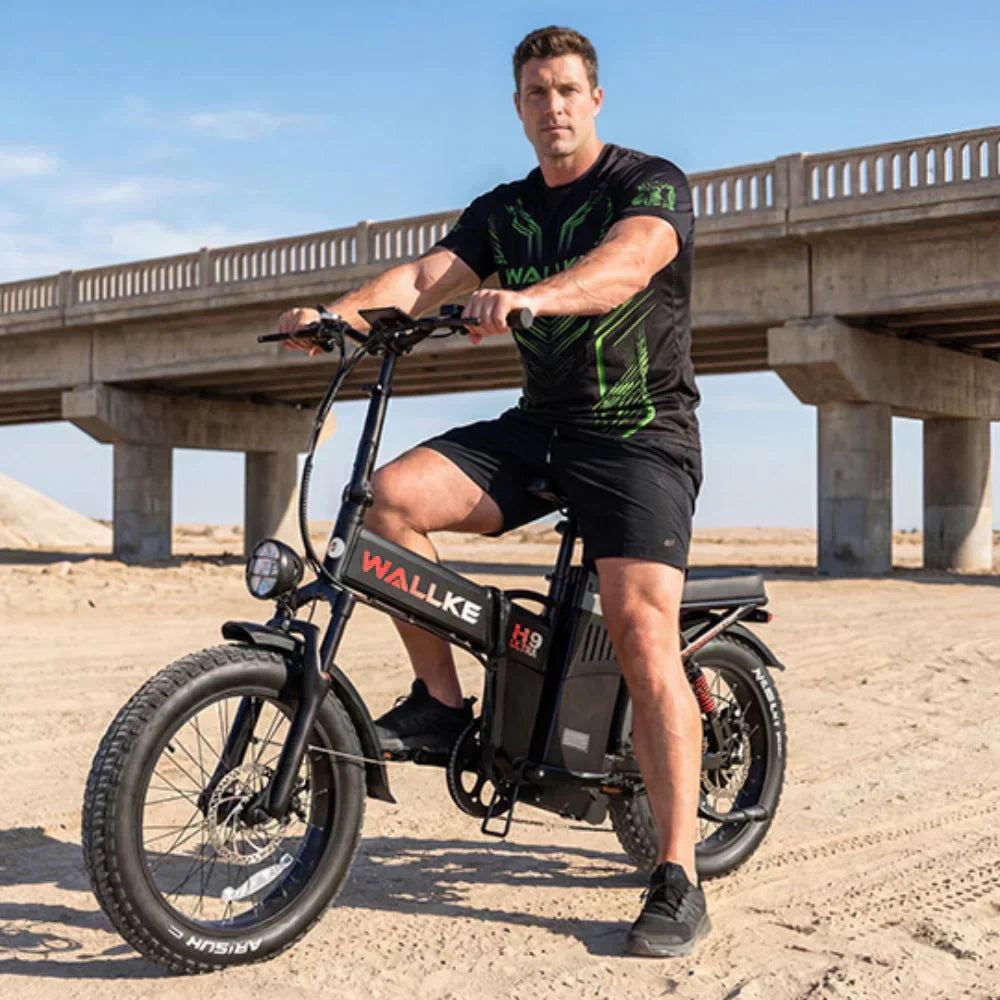
| Wallke H9 AWD | Riders who want dual-motor traction, fat tires, full suspension, and compact storage. | Listed with dual 1000W motors, 3200W peak power, up to 150N·m torque, 20 x 4-inch fat tires, 400 lb max load, and battery configurations that may vary by selected variant and availability. | Use the appropriate legal mode for public roads and paths. Higher-power or higher-speed use may be restricted by local law. |
| Wallke H9 Ultra | Riders who want a folding long-range model with a torque-sensor ride feel and off-grid utility features. | Listed with 55Ah / 77Ah battery options depending on configuration, a torque sensor, 20 x 4-inch tires, 400 lb max payload, full suspension, and folding utility. | Weight details should be checked on the live product page before purchase because product-page sections may vary by configuration. |
If you are still comparing models, start with the full Wallke folding e-bike collection. You can also compare all Wallke electric bikes if you are not sure whether a folding, step-through, commuter, off-road, or dual motor model is the right fit.
Final Verdict: Are Folding Electric Bikes Worth It?
Folding electric bikes are worth it if storage, transport, and flexibility are important parts of your buying decision. They are especially useful for adults who want an e-bike for apartments, RV travel, commuting, errands, camping, or multi-purpose riding.
The key is to choose the right type of folding e-bike. If you want something light to carry every day, prioritize low weight and compact folded dimensions. If you want long range, hills, comfort, cargo support, and rough-road confidence, prioritize battery capacity, torque, brakes, fat tires, suspension, and payload rating.
A folding design is not automatically better or worse than a regular e-bike. It is a feature that becomes valuable when it solves a real problem in your life.
FAQ: Folding Electric Bikes
Are folding electric bikes worth it?
Yes. Folding electric bikes are worth it if storage, transport, and flexibility matter to you. They are especially useful for apartments, RV travel, commuting, errands, and riders who want an e-bike that can fit into tighter spaces than a regular full-size model.
Are folding electric bikes any good?
Good folding electric bikes can be very capable, but quality varies. Look for a strong frame, secure hinge, dependable brakes, enough battery capacity, a clear payload rating, and tires that match your terrain. Do not judge a folding e-bike only by its folded size.
What are the disadvantages of folding electric bikes?
The main disadvantages are weight, added frame complexity, smaller-wheel ride feel on some models, and the fact that not every folding e-bike is easy to carry. Heavy-duty folding fat tire e-bikes can be compact for storage but still heavy because of their battery, motor, frame, tires, and suspension.
Are folding electric bikes safe?
Folding electric bikes can be safe when they are well built, assembled correctly, maintained, and used within local rules. Check the frame, hinge, handlebars, brakes, throttle, lights, tires, cables, battery system, charger, and payload rating. Wear a helmet and follow local traffic laws.
Is a folding e-bike better than a regular e-bike?
A folding e-bike is better if storage and transport matter most. A regular e-bike may be better if you have plenty of space and prefer the most traditional full-size ride feel. The better choice depends on your commute, terrain, storage space, lifting requirements, and budget.
Can folding electric bikes handle hills?
Some folding electric bikes can handle hills well, especially models with strong torque, suitable gearing or drive configuration, fat tires, quality brakes, and enough battery capacity. Lightweight low-power folding bikes may struggle on steep climbs, especially with heavier riders or cargo.
Are folding electric bikes good for adults?
Yes. Folding electric bikes can be good for adults when the frame size, payload rating, motor system, brakes, riding position, and folded dimensions match the rider. Adults should pay close attention to maximum payload, comfort, braking performance, and real-world range.
Are folding fat tire e-bikes worth it?
Folding fat tire e-bikes are worth it for riders who want compact storage plus more traction and comfort on rough pavement, gravel, campground roads, beach paths, or mixed terrain. The trade-off is weight: fat tire folding e-bikes are usually heavier than narrow-tire compact models.
What should I look for in the best folding electric bike?
Look for a strong frame and hinge, enough battery capacity, a motor system suited to your terrain, hydraulic disc brakes, appropriate tire size, clear payload rating, safe charging guidance, warranty support, and folded dimensions that fit your storage space.


Leave a comment