
A larger battery or a second motor may help on some routes, but neither tells you whether the bike will fit, carry your luggage, stop confidently under load, or remain manageable when the battery runs low.

Quick answer
Start with the roads you actually ride. For paved routes and light gravel, prioritize fit, predictable pedal assistance, dependable brakes, cargo support, integrated lights, and enough battery capacity for the loaded route with a meaningful reserve. A step-through frame helps with frequent stops. A folding frame helps only when its folded size and lift weight work for your storage or vehicle. Consider AWD only when repeated steep or loose-surface starts create a real traction need.
What is a trekking electric bike?
A trekking electric bike is a practical, multi-purpose e-bike for longer rides. It sits between a commuter bike and a mountain bike. The category is common in Europe. shoppers may also use terms such as electric touring bike, hybrid e-bike, adventure e-bike, or long-distance e-bike.

| Bike type | Best for | Typical priorities | Main compromise |
|---|---|---|---|
| Trekking / touring e-bike | Long rides, errands, rail trails, light gravel, loaded day trips | Comfort, range, rack, lights, fenders, stable handling | Usually heavier than a basic commuter |
| Commuter e-bike | Daily paved trips and predictable routes | Efficiency, reliability, low maintenance, easy parking | May have less cargo or rough-road capability |
| Electric mountain bike | Technical trails and steep off-road terrain | Suspension, traction, trail geometry, control | May lack racks, fenders, lights, or touring comfort |
| Fat-tire adventure e-bike | Loose surfaces, rough roads, sand, snow, heavy loads | Grip, stability, comfort, strong braking | More weight and rolling resistance |
Choose a trekking e-bike by route and use case
A bike built for loaded gravel trips can be unnecessarily heavy on a paved rail trail, while a light commuter may feel underprepared on loose climbs. Match the setup to the route you expect to ride most often.
| Riding scenario | Look for | Avoid buying only for |
|---|---|---|
| Mostly paved roads and bike paths | Natural pedal assist, efficient tires, upright fit, lights, fenders, rack | Maximum tire width or maximum motor output |
| Long days with panniers | Battery capacity in Wh, stable rack, brake control, charger plan, serviceable parts | A headline range number without test conditions |
| Gravel, broken pavement, forest roads | Wider tires, suspension, strong wheels, predictable low-speed handling | Trail-racing geometry that is uncomfortable for hours |
| Steep hills or heavy loads | Strong low-speed assistance, appropriate gearing, hydraulic brakes, thermal margin | Top speed |
| Easy mounting and frequent stops | Step-through frame, stable stand-over feel, reachable controls | A frame that looks sporty but is hard to mount when loaded |
| Vehicle transport or compact storage | Folding frame, measured folded dimensions, a realistic lifting plan | The word “folding” without checking total weight |
What to check before buying an electric touring bike

Fit and riding position
A promising specification sheet does not compensate for an awkward reach, difficult mounting, or unstable handling at walking speed. Check the actual frame size, not only a broad rider-height range. Look for adequate saddle adjustment, a comfortable handlebar position, and stand-over clearance that still works after panniers are loaded. A one-size frame may not fit every rider. An adjustable stem can help, but it does not replace a proper test ride.
Battery capacity, removal, and indoor charging
For a basic capacity comparison, multiply the battery’s nominal voltage by its amp-hour rating to estimate watt-hours. Watt-hours do not by themselves predict real-world range.
Confirm whether the battery is removable, how much it weighs, how securely it locks, and whether the connector is designed for frequent removal. This matters when a hotel or apartment does not allow the complete bike indoors. Also check charging time, charger size, charger weight, and whether the charger can fit safely in your normal pannier.
How the advertised range was produced
Range changes with rider weight, cargo, hills, wind, temperature, tire pressure, speed, stops, surface, and assist level. Treat an advertised range as a result under particular conditions, not as guaranteed mileage for your own trip.
- Start with the lower end of the published estimate.
- Plan from your heaviest normal load.
- Include the longest climb and the return trip.
- Keep a meaningful reserve for weather, detours, and uncertain charging.
Pedaling with the assistance turned off
Before buying, switch the assistance off and ride the bike on level pavement and a gentle incline. That quickly shows how its weight, tires, gearing, and motor drag affect a depleted-battery ride. Shift into the lowest gear and decide whether you could manage several miles.
Motor and sensor behavior
A torque-sensing system measures pedal force as part of its assist calculation, although the final response still depends on controller programming and motor tuning. Some cadence-sensing systems deliver assistance with less proportional response. Test starts, tight turns, and low-speed riding rather than judging the system by the sensor name alone.
Hub motors are common and straightforward. Mid-drive systems can use the bicycle’s gears efficiently on climbs, but drivetrain wear and service needs may differ. Choose a system that can be supported along your normal route.
Braking with the bike fully loaded
Rider, bike, battery, panniers, water, tools, and camping gear all increase stopping demand. Hydraulic disc brakes often require less lever effort, but stopping performance also depends on rotor size, pad condition, system setup, tire grip, total load, road surface, and rider technique.
Tires, gearing, and field repair
Wider tires can improve comfort and grip on gravel, sand, broken pavement, and loose shoulders, but they add weight and rolling resistance. Compared with common conventional-bike sizes, 20×4 and especially 20×5 replacement tires and tubes may be less widely stocked by general bike shops and are bulkier to carry. Before touring, call shops along the route and ask whether they stock the exact tire and tube size.
Confirm that the lowest gear is usable when the motor is off. A hub-motor rear wheel may require extra tools or connector knowledge for tube replacement. Check whether the chain, cassette, derailleur, brake pads, and wheel hardware are commonly available.
Cargo and vehicle transport
Check the rear rack’s own rated load, pannier clearance, heel clearance, attachment points, and fender clearance. The bike’s total payload rating is not the same as the rear-rack rating.
For vehicle transport, confirm the rack’s total capacity, per-tray capacity, tire-width limit, wheelbase limit, hitch class, and the bike’s weight with and without the battery. Many heavy e-bikes are easier to secure on a platform-style carrier, but use only a rack whose manufacturer explicitly supports the bike’s weight, frame design, wheelbase, and tire width.
Parts and service support
A replaceable display, brake pad, charger, connector, or wheel part may matter more on tour than another headline feature. Confirm that you can obtain the correct brake pads, charger, display, controller, keys, battery hardware, connectors, and wheel-removal tools before relying on the bike far from home. Ask whether a replacement battery is expected to remain available, what shipping restrictions apply, and whether it can be serviced or replaced after the warranty period.
How to plan real-world electric touring bike range
Do not plan a tour by copying the maximum range printed on a product page. Build a route budget from the battery, total load, terrain, weather, assist level, and confirmed charging access.

- Record nominal battery capacity. Multiply volts by amp-hours for a basic Wh comparison.
- Define the loaded trip. Include rider, water, locks, tools, clothing, and panniers.
- Mark climbs, rough surfaces, and exposed windy sections.
- Use a realistic assist level. Do not assume the lowest mode will be comfortable all day.
- Confirm charging stops. Ask whether the outlet is available and whether battery charging is allowed.
- Keep a meaningful reserve. The amount depends on terrain, weather, load, charging certainty, and motor-off rideability.
- Run a loaded test ride. Recreate the expected speed, surface, climbing, and luggage.
For a deeper battery calculation, see Wallke’s guide to planning real-world e-bike range and long-range e-bike battery care guide.
Single motor or dual motor for touring?
A suitable single-motor bike is often easier to manage for paved touring, moderate hills, and efficiency-focused rides. It normally carries less drive hardware and has fewer motor-related components to service.

Consider a dual-motor configuration only after confirming that repeated steep starts or loose surfaces create a traction need that a suitable single-motor bike cannot meet. Compare the added weight, energy use, low-speed control, wiring, service complexity, and legal riding modes.
A second drive motor does not add braking grip or shorten stopping distance by itself. Tires, brakes, load, road surface, and rider control remain decisive. For a fuller comparison, read Wallke’s single- and dual-motor e-bike guide.
How current Wallke models map to these use cases
Wallke’s lineup leans toward high-capacity batteries, fat tires, cargo support, and heavy-duty frames. Those traits can suit riders carrying more gear or using rougher roads, but they also make weight, storage, vehicle transport, and route legality especially important.

| Model family | Best fit | Useful traits | Check before buying |
|---|---|---|---|
| H7 Ultra | Easy mounting, long days, mixed pavement and light gravel | Step-through frame, torque-sensor configurations, fat tires, rear rack and cargo support | Total weight, current motor and battery configuration, route class rules |
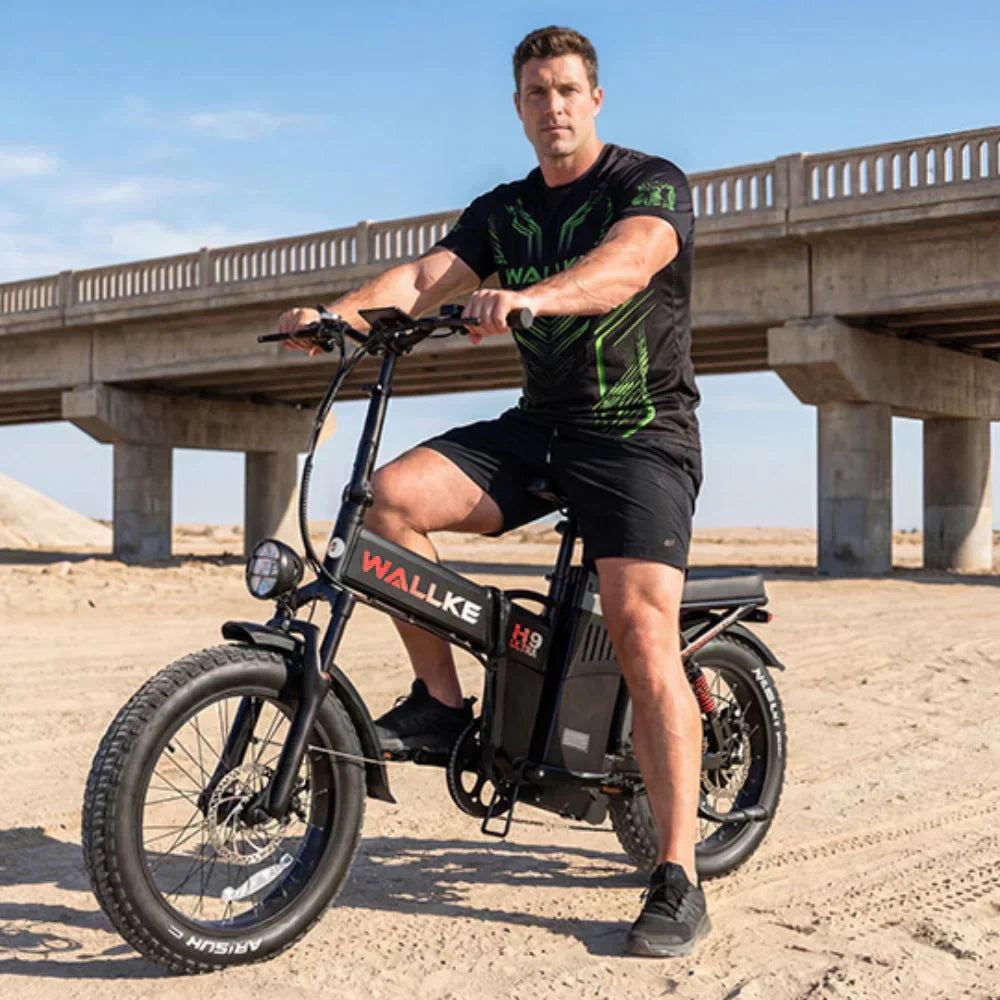
| H9 Ultra | Folding storage combined with touring capability | Folding frame, torque-sensor configurations, fat tires, rack, current battery options | Folded dimensions, lift weight, vehicle capacity, current model-year and configuration |
| H7 AWD | Step-through access with frequent hills or loose-surface starts | Dual-motor drive, hydraulic disc brakes, lighting and rear cargo support | Energy use with both motors, total weight, legal riding mode |
| H9 AWD | Folding storage with recurring AWD traction needs | Folding frame, AWD and available battery configurations shown on the live product page | Lift and transport plan, turning space, route access and current variant details |
| R60 series | Outside the traditional trekking category; heavy-duty rough-road use | Large battery configuration, wide tires and heavy-load focus | Very high bike weight, storage, carrier limits and public-route legality |
H7 Ultra
Best fit: Easy mounting and mixed pavement or light gravel.
Check: Weight, selected motor and battery configuration, and route rules.
H9 Ultra
Best fit: Folding storage combined with touring capability.
Check: Folded dimensions, lift weight, vehicle capacity, model year, and selected variant.
H7 AWD
Best fit: Step-through access with repeated hills or loose-surface starts.
Check: Energy use, total weight, and legal riding mode.
H9 AWD
Best fit: Folding storage with a recurring AWD traction need.
Check: Lift plan, turning space, route access, and live variant details.
R60 Series
Category: Outside the traditional trekking category.
Best fit: Very high-capacity, heavy-duty rough-road use.
Check: Bike weight, storage, carrier limits, and public-route legality.
For traditional paved touring, start with the lightest configuration that meets your range, comfort, cargo, and hill needs. Added drive hardware is worthwhile only when its traction benefit outweighs the additional weight, energy use, wiring, and service complexity on your regular route.
Charging, transport, weather, and route planning
Confirm battery removal and indoor charging
Ask whether the battery can be removed without tools, how much it weighs, and whether the lock and connector suit frequent removal. Confirm whether lodging providers allow the complete bike indoors or only the battery. Never assume an outdoor outlet is available or approved for e-bike charging.
Carry a charger that fits the trip
Check charging time, charger weight, charger dimensions, cord length, and plug requirements. A large charger may occupy meaningful pannier space. Carry the supplied charger or a manufacturer-approved replacement; do not substitute a charger only because the connector fits.
Charge safely
Follow the manufacturer’s instructions, remain present while charging, use only the supplied or manufacturer-recommended charger, and stop charging immediately if the battery, charger, or connection shows damage or abnormal behavior.
Air travel is a major limitation
For ordinary passenger baggage, lithium-ion batteries are generally limited to 100 Wh. Certain 101–160 Wh batteries may be accepted with airline approval. Recreational devices with batteries above 160 Wh are prohibited as carry-on or checked baggage. Disability mobility devices follow separate rules. Most full-size e-bike batteries are therefore unsuitable for passenger baggage.
For a fly-and-ride trip, consider renting a compatible e-bike or battery at the destination, or use a qualified shipping service. Confirm the arrangement before buying tickets.
Check vehicle-rack limits
Confirm hitch class, total rack capacity, per-tray capacity, wheelbase, tire width, and whether the battery must be removed before transport. Do not assume a rack rated for two conventional bicycles can carry one heavy fat-tire e-bike.
Plan for rain and water exposure
Check the manufacturer’s current water-resistance instructions for the battery, display, wiring, and charging port. Allow wet components to dry as directed before charging. Do not use a pressure washer unless the manufacturer explicitly permits it.
Check every trail and jurisdiction
Within National Park Service units, e-bikes may be used only where traditional bicycles are allowed, and park superintendents may impose local restrictions. Traditional bicycles and e-bikes are prohibited in designated wilderness. State, city, park, and trail-manager rules can differ, so check the exact route and the bike’s configured riding mode.
Plan overnight parking and theft protection
Ask whether lodging permits the full bike indoors and whether secure overnight storage is available. Check whether the battery, display, and panniers can be removed quickly. Use locks suitable for the bike’s frame and value, and review whether your insurance covers theft while traveling.

Carry a realistic field kit
- The exact tube or tubeless repair supplies used by the bike
- A pump or inflator sized for the tire volume
- Tire levers and the tools needed to remove the motor wheel
- Brake-pad and fastener tools used by the bike
- Spare key, charger information, and important connector details
- Basic first-aid supplies, lights, and reflective gear
- An offline route, emergency contact, and planned bailout points
Final trekking e-bike buying checklist
Load the bike with the weight you expect to carry, then perform a hill start, a tight turn, a controlled stop, and a short motor-off ride. Finish by lifting, folding, or storing it exactly as you would at home. Those checks reveal more than another page of specifications.
Frequently asked questions
What is a trekking electric bike?
A trekking electric bike is a versatile e-bike designed for longer rides, daily transportation, and mixed paved or light unpaved routes. It usually combines a comfortable riding position with lights, cargo support, practical gearing, and a battery sized for more than short city trips.
Are e-bikes good for long-distance touring?
Yes, when the bike fits the route and the charging plan. Evaluate battery capacity in watt-hours, real-world range under load, charger size and weight, charging time, cargo capacity, repair access, and how the bike pedals with the motor turned off.
How should I plan battery capacity for touring?
Multiply nominal volts by amp-hours for a basic watt-hour comparison, then plan from your loaded route, hills, surface, weather, assist level, and confirmed charging stops. Keep a meaningful reserve instead of planning to arrive at zero.
Can you pedal an electric touring bike with the motor off?
Most e-bikes can still be pedaled, but the experience varies. Heavy frames, fat tires, hub motors, luggage, gearing, and motor drag can make an unassisted bike much harder to move. Test it on level ground and a gentle incline before buying.
Is a single motor or dual motor better for trekking?
A suitable single motor is often easier to manage for paved touring and moderate hills. Consider dual motors only when repeated steep or loose-surface starts create a real traction need. Compare added weight, energy use, control, service complexity, and legal riding modes.
Are fat tires good for electric bike touring?
Fat tires can add grip, stability, and comfort on gravel, sand, broken pavement, and loose surfaces. They also add weight, rolling resistance, and repair bulk. Confirm that the exact tire and tube size is available along your route.
Can you take an e-bike battery on an airplane?
For ordinary passenger baggage, lithium-ion batteries are generally limited to 100 Wh, while certain 101–160 Wh batteries may require airline approval. Recreational batteries above 160 Wh are prohibited as carry-on or checked baggage. Most full-size e-bike batteries exceed those limits.


Leave a comment