
Quick answer: how to choose an electric mountain bike
Start with four questions:
- What surfaces will you ride most? Technical singletrack, smooth trails, forest roads, pavement, sand, or snow?
- What e-bike class is allowed there? Trail access can make an otherwise capable bike the wrong purchase.
- Can you handle and transport the bike? Weight matters every time you lift, turn, repair, store, or rack it.
- Who will service it? Brakes, suspension, motor, controller, display, and battery need a realistic support path.
For regular technical-singletrack use, begin by comparing properly sized Class 1 mid-drive trail e-MTBs, then decide whether your terrain justifies full suspension. A hardtail can be the better choice for smoother trails, lower maintenance, and a tighter budget. Fat-tire all-terrain e-bikes serve a different purpose: mixed surfaces, utility riding, sand, snow, comfort, and stability.
One-minute eMTB decision guide
Start with a Class 1 mid-drive trail e-MTB when:
- You regularly ride natural-surface trails and the exact route permits that class
- Balanced handling and controlled low-speed climbing matter
- You have access to appropriate bicycle and electrical-system service
Add full suspension when:
- Your normal routes include repeated rough descents, roots, rocks, drops, or higher-speed trail sections
- The added cost, weight, setup, and shock maintenance are justified by the terrain
Choose a hardtail e-MTB when:
- You ride smoother trails, gravel, forest roads, or mixed surfaces
- You value lower maintenance and stronger component value at the same budget
Choose a light-assist e-MTB when:
- You want handling closer to a regular mountain bike
- You accept less assistance and a smaller energy reserve in exchange for lower weight
Choose a fat-tire all-terrain e-bike when:
- Your riding mixes pavement, dirt roads, utility use, sand, or snow
- Stability, comfort, battery capacity, or cargo matter more than agile singletrack handling
- You can safely manage its weight and have confirmed local access rules
Bike class does not create automatic trail access. Verify the current rule for the exact route.
What counts as an electric mountain bike?
An electric mountain bike, often called an e-MTB, combines an off-road bicycle frame with a motor and rechargeable battery. The motor assists the rider while climbing and pedaling, but the category covers very different machines.
A lightweight, mid-drive trail bike and a high-power, fat-tire all-terrain e-bike may both appear in search results for “electric mountain bike.” They do not ride the same way, fit the same trails, or solve the same problem.
| Category | Usually best for | Common design priorities | Main trade-off |
|---|---|---|---|
| Trail-focused e-MTB | Singletrack, repeated climbs, technical descents | Mid-drive motor, mountain-bike geometry, 27.5- or 29-inch wheels, trail tires, lower central weight | Higher price and more specialized maintenance |
| Hardtail e-MTB | Green and blue trails, gravel, forest roads, cross-country use | Front suspension, efficient pedaling, simpler frame | Less comfort and traction on rough descents |
| Fat-tire all-terrain e-bike | Mixed pavement and dirt, sand, snow, utility riding, stability | Wide tires, larger batteries, hub motors, racks, comfort features | More weight and slower, less agile handling on narrow trails |
| Light-assist e-MTB | Riders who want a more natural mountain-bike feel | Lower system weight, moderate assistance, playful handling | Less peak assistance and often less battery capacity |
1. Define where and how you will ride
A common mixed-use question is: “What should I buy if most of my riding is in town and only some is on dirt?” Start with the surface you ride most, then check whether the bike remains manageable and legal on the smaller part of your route.
Technical singletrack and steep climbs
Prioritize a mid-drive motor, predictable pedal assistance, strong hydraulic brakes, trail geometry, suitable tires, and either a capable hardtail or full suspension. A lower center of mass and balanced handling matter more than a large advertised watt number.
Smooth trails, gravel, and forest roads
A hardtail e-MTB often makes sense. It is simpler, easier to maintain, and usually offers better components for the same budget than an entry-level full-suspension bike.
Mixed city riding and occasional dirt
Look beyond the traditional e-MTB category. Comfort, lights, fenders, rack capacity, tire durability, and a removable battery may matter more than long suspension travel. A fat-tire or off-road e-bike can be a practical choice when the “mountain” portion is mostly gravel, dirt roads, and easy paths.
Sand, snow, hunting access, and utility riding
Wide tires can add flotation and stability. Soft surfaces can increase energy use, so additional battery capacity may provide more reserve, but it also adds weight. Check whether you need a rack, cargo capacity, low-speed control, and field-repairable tires. Our off-road e-bike buying guide covers this use case in more detail.
Long rides far from a charger
Battery capacity matters, but so do efficiency, temperature, elevation, and the ability to turn around with a reserve. A huge battery is not automatically better if it makes the bike too heavy for your rack, stairs, or repair stand.

2. Check e-bike class and trail access before power
The three-class framework below is commonly used in the United States, but definitions, equipment requirements, and access rules can vary by state and local jurisdiction. The National Park Service, for example, allows park-specific restrictions and conditions.
| Common class | Assistance | Typical assisted-speed limit | Buying implication |
|---|---|---|---|
| Class 1 | Pedal assist | 20 mph | Class 1 is commonly the first category to check for natural-surface trail access, but permission depends on the state, land manager, park, and exact trail. |
| Class 2 | May provide motor assistance without pedaling | 20 mph | Throttle assistance can be useful for starts and utility riding, but some routes restrict throttle-equipped bikes. |
| Class 3 | Pedal assist | 28 mph | Higher assisted speed may suit transportation, while natural-surface access must be checked route by route. |
Use this three-step access check before buying:
- Check the state’s current definition and operating requirements for electric bicycles.
- Check the city, park, forest, or land manager that controls the area.
- Check the posted rule for the exact trail or route, including throttle restrictions and seasonal closures.
- Confirm that the selected configuration can operate within the permitted class without an unofficial modification.
- Confirm whether throttle use is allowed.
- Confirm whether the bike still qualifies as an electric bicycle under the applicable rule.
3. Choose the motor system: mid-drive vs. hub drive
The motor’s location and tuning affect handling more than a single watt figure.
| Factor | Mid-drive motor | Hub-drive motor |
|---|---|---|
| Technical climbing | Uses the bike’s gears and usually performs well at low climbing speeds | Can be strong, but performance depends heavily on motor winding, controller tuning, traction, and heat |
| Handling | Mass is centered near the crank | Adds weight to the front or rear wheel |
| Drivetrain wear | Motor power passes through the chain and cassette | Motor drives the wheel independently of the bicycle drivetrain |
| Service | More integrated and often dealer-dependent | Can be mechanically simpler, but wheel and wiring service may be specialized |
| Best fit | Technical trail riding and riders who value natural pedal response | Mixed-surface, utility, fat-tire, and high-power all-terrain use |
Full-power vs. light-assist e-MTBs
Full-power system
- More assistance for sustained climbing and longer high-assist use
- Usually paired with a larger battery and higher total bike weight
- Useful when assistance is the priority and transport weight is manageable
Light-assist system
- Ride feel and handling can be closer to a regular mountain bike
- Lower transport weight, with less assistance and energy reserve
- Useful for fitter riders, shorter routes, and riders who prioritize handling
Do not compare the labels alone. Check system weight, usable battery capacity, assistance behavior, climbing expectations, and whether the motor and battery can be serviced or replaced locally.
Torque matters, but the number is not the whole story
Torque figures can hint at low-speed assistance, but they are not directly comparable across motor systems. Gearing, software, wheel size, traction, and total bike weight change how that torque feels.
Do not shop by peak watts alone
Peak power and rated power describe different operating conditions. Ask what each figure represents, how it was measured, and whether the stated output is consistent with the bike’s intended legal class.
On slow technical climbs, a mid-drive can use the bicycle’s gears to keep the motor operating efficiently. That can be an advantage over some hub-drive systems, but performance varies by system and conditions.
Cadence sensor or torque sensor?
- Torque sensor: Assistance responds to how hard you pedal. It usually feels more controlled on loose climbs and technical terrain.
- Cadence sensor: Assistance responds mainly to crank rotation. It can feel more abrupt, but may suit riders who want easy effort on roads and open terrain.
What about dual motors?
Driving both wheels may provide additional propulsion on some loose or steep surfaces, but usable traction still depends on tires, surface conditions, weight distribution, controller tuning, and rider control. They also add weight, complexity, battery demand, and possible access issues. Compare the trade-offs in our single- vs. dual-motor e-bike guide.

4. Compare battery capacity and realistic range
Use watt-hours (Wh) when comparing battery capacity:
Volts × amp-hours = watt-hours.
For example, a 48V 20Ah battery is about 960Wh. Watt-hours do not guarantee a specific range, but they are more useful than comparing amp-hours without voltage.
Why published range numbers vary
Actual range changes with:
- Elevation gain and trail steepness
- Assistance level and throttle use
- Rider, cargo, and bike weight
- Tire width, tread, and pressure
- Soft sand, snow, mud, or loose soil
- Temperature and wind
- Speed, stops, and acceleration
- Battery age and condition
Battery details worth checking
- Capacity in watt-hours
- Whether the battery is removable
- Battery and charger replacement availability
- Charging time and charger output
- Exact safety certification claim for the electrical system or battery
- Storage temperature guidance
- Replacement cost and warranty exclusions
For long-range use, also think about charging logistics and battery weight. A very large battery can improve endurance while making the bike difficult to lift or transport. Battery care matters after purchase; see our long-range e-bike battery care guide.
5. Choose hardtail or full suspension
Pay for rear suspension when your normal routes include rough terrain, repeated descents, roots, rocks, or higher speeds. On smoother trails, the same budget may buy a better-equipped hardtail.
| Question | Hardtail e-MTB | Full-suspension e-MTB |
|---|---|---|
| Best terrain | Smoother trails, cross-country routes, gravel, forest roads | Rocky, rooty, steep, and repeated technical terrain |
| Weight and efficiency | Usually lighter and more direct | Usually heavier, with more moving parts |
| Traction and control | Good on smoother surfaces | Better rear-wheel contact on rough ground |
| Maintenance | Simpler | Fork, rear shock, pivots, and bearings need service |
| Budget efficiency | More money can go toward brakes, drivetrain, battery, and fork | Cheap suspension can look impressive without performing well |
Suspension travel is not a quality rating
More travel can help on large impacts, but it does not guarantee good damping, stiffness, geometry, or setup. Ask whether the fork and shock have adjustable air pressure, rebound control, service support, and replacement parts.
Frame geometry matters
Reach, head angle, chainstay length, wheelbase, bottom-bracket height, and seat-tube angle affect climbing position and descending stability. You do not need to memorize every number. You do need a size that places you in control without feeling cramped or stretched.

6. Get the fit, wheel size, tires, and weight right
Fit comes before motor power
A poor fit reduces control and can make a heavy e-bike feel even harder to manage. Use the manufacturer’s size chart as a starting point, then check:
- Standover clearance
- Reach to the handlebar
- Seated pedaling position
- Ability to move behind and around the saddle
- Brake lever reach
- Dropper-post insertion and saddle height
Wheel and tire choices
- 29-inch wheels: Roll over obstacles well and are common on trail and cross-country e-MTBs.
- 27.5-inch wheels: Can feel easier to maneuver and may suit smaller riders or tighter trails.
- Mixed “mullet” setup: A 29-inch front and 27.5-inch rear can combine rollover with rear-wheel agility.
- 20-inch fat tires: Add stability, flotation, and compact packaging, but do not handle like a traditional 27.5- or 29-inch mountain bike.
Bike weight changes ownership
Weight affects more than trail feel. It determines whether you can lift the bike into a vehicle, carry it upstairs, turn it around on a narrow trail, load it onto a repair stand, and use your existing rack.
Check the rack’s total capacity and its maximum weight per bike. Remove the battery before lifting when the manufacturer allows it. Also verify the bike’s wheelbase, tire width, and fender clearance against the rack.
Rider and cargo limits deserve the same attention. Our electric bike weight limit guide explains why payload, rack limits, braking, tires, and frame fit should be considered together.
7. Check brakes, drivetrain, suspension quality, and durability
Brakes
A heavier bike and higher riding speed increase braking demand, especially during repeated or sustained descents. Hydraulic disc brakes are a strong baseline for mountain use, but rotor size, caliper design, pad availability, lever feel, and correct setup also matter.
During a test ride, brake firmly from a safe speed. The levers should not pull to the handlebar. The bike should stop in a straight, controlled line without severe vibration or grinding.
Drivetrain
A wide gear range helps a mid-drive motor climb efficiently. Check whether replacement chains, cassettes, chainrings, derailleur hangers, and shift parts are readily available. High motor torque can accelerate drivetrain wear when the rider shifts under full load.
Tires and wheels
Look for tire tread and casing suited to your terrain. Soft trail tires can grip well but wear quickly on pavement. Fat tires add flotation but require correct pressure; too much pressure reduces traction, while too little can cause squirm or rim strikes.
Water resistance
A water-resistance rating is not permission to submerge the bike, pressure-wash bearings, or charge a wet battery. Ask which components the rating applies to and follow the manufacturer’s cleaning and drying instructions.
Compatibility and long-term ownership
Before buying, confirm the parts that are easiest to overlook:
- Derailleur-hanger availability
- Brake-pad and rotor availability
- Tire casing, tube size, and tubeless compatibility
- Front and rear axle standards
- Dropper-post diameter and insertion depth
- Fork and shock service support
- Battery, controller, display, sensors, and wiring availability
8. Verify battery safety, service, spare parts, and warranty support
Before buying, identify who will service the brakes, drivetrain, suspension, motor, controller, display, and battery.
Battery and electrical safety
For U.S. buyers, look for a clearly stated certification to an applicable standard. UL 2849 evaluates the electrical drive train, battery, and charger as a system combination. Do not treat “uses UL parts” as proof that the complete e-bike system is certified. Verify the exact model, system, standard, certification body, and active listing.
- Use the supplied charger or a replacement specifically tested and approved for that device; see the CPSC charger safety guidance.
- Do not charge a damaged, swollen, leaking, or unusually hot battery
- Keep the charging area clear and follow the manufacturer’s supervision guidance
- Confirm how replacement batteries will be sourced and shipped
Service before purchase
Ask a local shop whether it will work on the bicycle. Some shops service brakes, tires, and drivetrains but will not diagnose unfamiliar electrical systems. Ask the seller who handles motor, controller, display, wiring, and battery claims.
Parts availability
Check for:
- Replacement battery and charger
- Brake pads and rotors
- Derailleur hanger or tensioner
- Display, controller, sensors, and wiring harness
- Fork and shock service parts
- Correct-size tubes or tires
Warranty questions
Read what is covered, for how long, and who pays shipping or labor. A long warranty headline is less useful when the battery, wear parts, commercial use, water damage, or labor are excluded.
How much should you spend on an electric mountain bike?
Budget should reflect the terrain the bike must handle and the level of component quality and service support that terrain requires.
Can an electric mountain bike under $2,000 be good?
A sub-$2,000 model may suit forest roads, recreational paths, and some smoother trails. The label alone does not establish trail capability. Screen the bike against your intended terrain and ownership needs.
| Intended use | Nonnegotiables | Likely compromises |
|---|---|---|
| Gravel and forest roads | Correct fit, reliable brakes, documented battery, replacement parts | Basic fork, high weight, limited adjustment |
| Easy trails | Trail-suitable tires, adequate brake capacity, durable wheels, service access | Entry-level suspension and drivetrain |
| Technical singletrack | Trail geometry, strong brakes, suitable fork, dependable wheels, local service | A sub-$2,000 model may not provide the component or support level required |
Where to spend first
- Correct size and geometry
- Brakes appropriate for the bike’s weight and terrain
- Battery and electrical safety
- Service and replacement parts
- Suspension and tires suited to your real routes
- Motor and battery capacity
- Displays, apps, and cosmetic extras
Budget for ownership
Include a helmet, suitable rack, lock, floor pump, spare tube or repair kit, brake pads, chain care, suspension service, and eventual battery replacement. The cheapest bike at checkout can become expensive when parts or service are unavailable.
Electric mountain bike test-ride checklist
A parking-lot ride is better than nothing, but it cannot reveal how a bike climbs, brakes, and changes direction on a trail. Use the closest legal terrain available.
- Start and stop on an incline
- Ride slowly through a tight turn
- Compare assistance modes without looking down for long
- Shift under light load and check gear range
- Brake firmly and progressively
- Stand on the pedals and move your weight forward and back
- Check heel, knee, and toe clearance
- Listen for rattles, chain slap, brake rub, or motor noise
- Lift the front and rear of the bike
- Practice removing and installing the battery
- Confirm the bike fits your rack or vehicle

Common electric mountain bike buying mistakes
- Buying the biggest watt number. Motor location, tuning, traction, gearing, and legal class may matter more.
- Ignoring trail access. A bike you cannot legally ride on your local trails is not the best e-MTB for you.
- Believing an unexplained range claim. Ask for the test conditions.
- Underestimating weight. Confirm your rack, vehicle, stairs, storage, and lifting ability.
- Choosing cheap full suspension over a better hardtail. Poor suspension adds weight and maintenance without reliable control.
- Ignoring replacement parts. Batteries, chargers, displays, controllers, brake pads, and tires must be obtainable.
- Assuming every “mountain e-bike” is a trail bike. Separate technical e-MTBs from fat-tire all-terrain and utility models.
- Skipping a fit check. Power cannot correct a frame that is too large, too small, or awkward to control.
- Confusing e-bikes with e-motos. High-speed devices outside the legal e-bike definition may face different rules.
Where Wallke fits—and where it does not
Wallke currently positions the H7 Ultra and H9 Ultra as heavy, fat-tire, all-terrain e-bikes for mixed-surface and utility use. They are not direct substitutes for lightweight, mid-drive Class 1 trail e-MTBs.
Current Wallke product pages list single-motor and AWD configurations. Single-motor configurations use a rear hub motor; AWD configurations use front and rear hub motors. Available batteries, weight, brakes, suspension, speed settings, and other specifications vary by selected configuration, so verify the exact variant before buying.

Good fit
- Mixed pavement, dirt roads, and open all-terrain routes
- Sand, snow, utility, cargo, or long-distance priorities
- Riders who value stability and can safely manage a heavy bike
- Buyers who have confirmed storage, transport, service, and legal access
Look elsewhere when
- Your main goal is narrow, technical singletrack
- You want traditional mountain-bike handling and low transport weight
- Your local routes allow only a specific Class 1 configuration
- You cannot safely lift, rack, store, or repair a heavy fat-tire bike
Wallke all-terrain options
Product pages and configurations can change. These cards link to the product detail pages rather than sending readers directly to checkout.
Wallke H7 Ultra
A step-through fat-tire all-terrain platform offered in configuration-dependent single-motor and AWD versions.
Best suited to- Mixed-surface riding and easier step-through access
- Large-battery, utility, and comfort priorities
- Selected motor layout, battery, complete-bike weight, brakes, speed/class settings, and local access
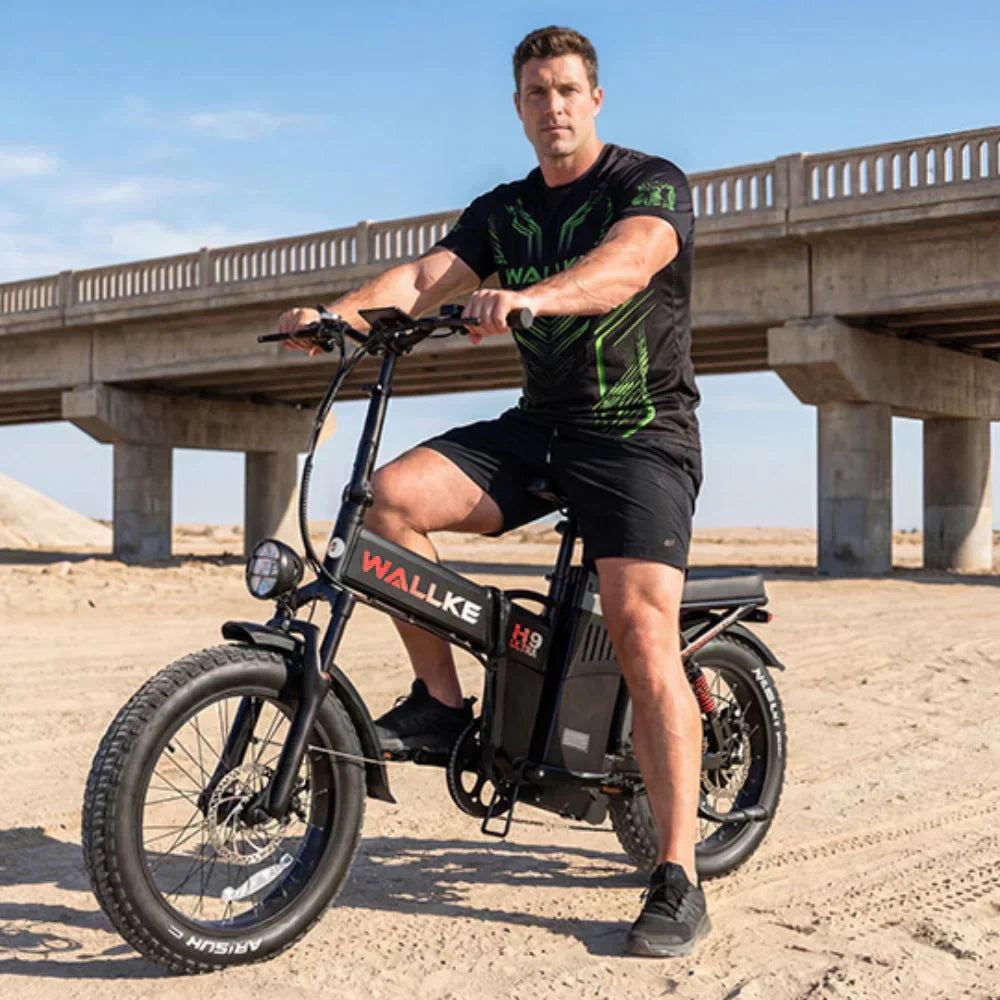
Wallke H9 Series
The Wallke H9 Series is a folding-frame fat-tire all-terrain platform with single-motor and AWD configurations. Motor layout, battery capacity, weight, brakes, and sensor type vary by selected version.
Best suited to- Mixed-surface and utility riders who specifically need the folding-frame format
- Large-battery and all-terrain priorities
- Selected motor layout, battery, folded dimensions, complete-bike weight, transport method, class settings, and local access
For more category options, browse Wallke’s fat-tire e-bikes. Riders comparing powertrain layouts can also review the dual-motor e-bike collection.
How this guide was researched
This article combines U.S. search-intent research, published component and product documentation, and official safety and access guidance. It does not claim hands-on testing of competitor bikes.
- Trail-access guidance: U.S. National Park Service. Always check the exact park, land manager, and trail.
- Electrical-system certification context: UL Solutions on UL 2849.
- Charger safety:U.S. Consumer Product Safety Commission.
- Wallke configuration statements: official Wallke H7 and H9 series product pages and linked model pages, checked August 6, 2026.
Manufacturer specifications and access rules can change. Recheck the selected SKU and exact route before purchase.
Frequently asked questions
What type of electric mountain bike should I buy?
For regular technical singletrack, start with a Class 1 mid-drive trail e-MTB if the exact route permits it. Choose full suspension for repeated rough descents, roots, rocks, and higher-speed terrain. Consider a hardtail for smoother trails, lower maintenance, and a tighter budget. Fat-tire all-terrain models are better suited to mixed pavement, dirt roads, sand, snow, and utility riding.
Is a mid-drive or hub-drive motor better for an electric mountain bike?
A mid-drive is often a strong choice for technical trail riding because it centers mass near the crank and can use the bicycle’s gears while climbing. A hub drive can be practical for mixed-surface, utility, and fat-tire all-terrain use. The better option depends on terrain, handling goals, total bike weight, and service access.
How many watts should a good electric mountain bike have?
Watts alone do not determine trail performance. Motor location, torque delivery, controller tuning, gearing, total weight, traction, and heat management all matter. For U.S. trail access, the bike's legal class may be more important than the largest advertised wattage.
Is a hardtail or full-suspension e-MTB better?
A hardtail is usually lighter, less expensive, and easier to maintain. Full suspension can improve control and comfort on repeated rough terrain. Pay for rear suspension when your normal routes will use it; on smoother trails, the same budget may buy a better-equipped hardtail.
How much battery capacity do I need?
Compare batteries in watt-hours, calculated as volts multiplied by amp-hours. Choose enough capacity for your longest normal ride with a reserve for hills, cold weather, soft ground, rider weight, and battery aging. Do not compare range claims unless the test conditions are similar.
Can I buy a good electric mountain bike for under $2,000?
Yes, but expectations matter. Under $2,000 can work for recreational paths, forest roads, smoother trails, and mixed-surface riding. Technical singletrack performance may be limited by suspension, brakes, weight, tires, geometry, or service support. Prioritize fit, braking, battery safety, and parts availability over headline power.
Is an electric mountain bike worth it?
It can be worth it if assistance helps you ride more often, climb more comfortably, cover longer routes, keep pace with a group, or return to riding after time away. It may not be worth it if you dislike the added weight, cannot use it on your local trails, or do not have a safe way to transport and store it.
How far can an electric mountain bike go on one charge?
Actual range varies widely with battery watt-hours, assistance level, elevation gain, speed, tire pressure, temperature, surface, rider and cargo weight, and how often the throttle is used. Treat a manufacturer's range as a scenario, not a guarantee, and ask how the number was measured.
Where can I ride an electric mountain bike in the United States?
Rules vary by state, city, park, trail system, and land manager. Some land managers permit Class 1 e-MTBs where throttle-equipped or higher-speed classes are restricted, but policies differ by route and can change. Check the current rule for the exact trail before buying or riding. This is general information, not legal advice.
What should I avoid when buying an electric mountain bike?
Avoid buying on wattage or claimed range alone. Also avoid unclear battery certification claims, proprietary parts with no replacement path, a bike too heavy for your rack, poor fit, weak brakes for the bike's weight, no local service option, and a class that is not allowed where you plan to ride.
Final buying checklist
Before buying, confirm that the bike:
- Is permitted on the exact routes you plan to use
- Fits your body and gives you confident low-speed control
- Can be lifted, stored, transported, and supported by your rack
- Uses a motor and assistance system that match your terrain
- Has enough battery reserve for your normal longest ride without relying on an unexplained maximum-range claim
- Has brakes, suspension, wheels, and tires appropriate for its weight and intended terrain
- Has a clear path for battery, charger, electrical, suspension, and mechanical service
- Has replacement parts and a warranty process you understand
A hardtail, a Class 1 full-suspension trail bike, a light-assist e-MTB, and a fat-tire utility model solve different problems. Select the category first; compare power and battery specifications second.

Leave a comment