
Quick answer: for firm, hard-packed beach sand, a stable single-motor e-bike with 4-inch fat tires, hydraulic brakes, and a sufficiently large battery may be all you need. For loose sand, heavier loads, frequent starts, or mixed coastal terrain, a dual-motor AWD fat tire e-bike usually provides better traction and momentum.
The best e-bike for sand is not automatically the bike with the highest peak wattage. Sand rewards a balanced setup: enough tire flotation to avoid sinking, progressive power that does not dig the wheels into the surface, battery capacity for extra rolling resistance, predictable braking, and a frame that supports the rider plus beach gear.
A fat tire ebike for sand also needs to match the surface. Firm, damp sand near the low-tide line is much easier than deep, dry upper-beach sand. No e-bike can make every dune or powdery patch effortless, and beach access rules may restrict high-power or throttle-equipped models.
Best Sand-Ready E-Bike Setups at a Glance
| Riding need | Recommended setup | Wallke option to compare |
|---|---|---|
|
Best overall traction Loose or mixed sand |
Dual-motor AWD, 4-inch fat tires, large battery, full suspension, hydraulic brakes | Wallke H9 AWD |
|
Best easy-access option Beach gear and frequent stops |
Step-through frame, dual-motor AWD, stable fat tires, strong payload support | Wallke H7 AWD |
|
Best long-range reference Hard-packed sand and coastal roads |
Single rear motor, torque sensor, 4-inch fat tires, high-capacity battery | Wallke H9 Ultra — availability may vary |
|
Best simple setup Firm sand and paved approaches |
4-inch fat tires, smooth pedal assist, hydraulic brakes, moderate bike weight | Compare the Wallke fat tire e-bike collection |
Important: these are configuration recommendations, not a promise that every beach permits every model. Confirm local access rules for the specific motor, throttle, speed, and class configuration you plan to ride.
Can You Ride an E-Bike on Sand?
Yes, an electric bike can ride on sand, especially when the surface is firm, damp, and compacted. Fat tires spread the combined weight of the bike and rider across a wider contact patch, so the wheels are less likely to cut deeply into the surface than narrow commuter tires.
Deep, dry sand is different. The front wheel can wander, the rear tire can spin, and the motor may draw considerably more energy. Starting from a stop becomes harder, especially with cargo or a heavy rider. A capable electric bike for sand improves traction and momentum, but it does not remove the need for route selection and smooth riding technique.
Practical rule: stay on firm sand when possible, keep your steering gentle, carry momentum through loose patches, avoid protected dunes and vegetation, and walk the bike when the surface becomes too deep or access is unclear.
Hard-Packed Sand vs. Soft Sand
“Sand” is not one consistent terrain. Moisture, tide, wind, slope, foot traffic, and vehicle tracks can change how the bike behaves within a few yards.
| Sand type | What it feels like | Recommended approach |
|---|---|---|
| Hard-packed wet sand | Firm, fast, and relatively predictable | 4-inch fat tires, moderate assist, smooth steering |
| Damp uneven sand | Rideable, but ruts and footprints add vibration | Fat tires, suspension, hydraulic brakes, reduced speed |
| Loose dry sand | High drag; wheels may wander or dig in | Lower pressure cautiously, easier gearing, steady torque, AWD when useful |
| Deep powdery sand or dunes | Very difficult and often environmentally sensitive | Avoid unless explicitly permitted; dismount before losing control |
| Saltwater edge | Slippery surface and high corrosion risk | Avoid direct water exposure and clean the bike after the ride |
What Makes an E-Bike Good for Sand?
A sand-ready e-bike should be evaluated as a complete system. Tires create flotation, the motor maintains momentum, the battery supplies the extra energy, and the brakes control a relatively heavy bike on ramps, access roads, and mixed surfaces.
1. Fat tires and adjustable pressure
Around 4 inches is a practical starting width for beach paths, hard-packed sand, and mixed terrain. A 20 x 4.0 tire combines a broad contact patch with compact handling and low-speed stability. Wider tires can add flotation in softer patches, but they also add weight and rolling resistance.
- Firm beach sand: 4-inch all-terrain fat tires are usually sufficient.
- Softer patches: additional width and lower pressure may help, within the tire maker's safe limits.
- Avoid: narrow, high-pressure commuter tires that are more likely to sink or wash out.
2. Controlled torque rather than peak wattage alone
Sudden throttle input can spin a tire and dig it into loose sand. Progressive pedal assist, a torque sensor, or careful throttle control helps the bike build momentum without wasting energy. Motor torque becomes more important when carrying gear, supporting a heavier total load, or climbing a soft beach access ramp.
3. Battery capacity for high-load riding
Sand increases rolling resistance and reduces real-world range. Coastal headwinds, low tire pressure, cargo, frequent starts, and dual-motor operation can increase consumption further. Compare watt-hours where possible and plan a larger reserve than you would for the same distance on pavement.
4. Hydraulic disc brakes and large rotors
Fat tire e-bikes are often heavy before the rider and cargo are added. Hydraulic disc brakes and large rotors provide more predictable stopping with less hand effort, which matters on wet access ramps, uneven paths, and mixed beach-to-road routes.
5. Frame strength, payload, and fit
The payload rating must cover the rider, clothing, locks, tools, and beach equipment. A stable frame, appropriate rider fit, secure rack support, and a low-speed geometry you can control are more useful than an aggressive appearance.
6. Suspension and mixed-surface comfort
Fat tires absorb small bumps, but suspension can improve control on rutted entrances, gravel parking areas, broken pavement, and coastal trails. Full suspension is not mandatory for hard-packed sand, but it is valuable when most rides combine several surfaces.
Single Motor vs. Dual Motor AWD for Sand
A capable single-motor fat tire e-bike can be the better choice for firm sand and relaxed coastal routes. It is generally simpler and more energy-efficient, and smooth power delivery may matter more than adding another motor.
Dual-motor AWD becomes more useful when the route includes loose patches, repeated starts, cargo, heavier riders, or steep access roads. Powering both wheels can improve low-speed pulling traction, but the bike will be heavier and may use the battery more quickly.
| Drive setup | Best use | Main tradeoff |
|---|---|---|
| Single rear motor | Hard-packed sand, paved approaches, long coastal rides | Less pulling traction when restarting in loose sand |
| Dual motor / AWD | Soft patches, cargo, heavier loads, uneven starts | More weight, battery demand, and legal/access considerations |
For a deeper comparison of efficiency and traction, see Wallke's guide to single vs. dual motor e-bikes.
Best Wallke E-Bikes for Sand-Focused Riders
Wallke should be considered within the broader buying checklist rather than treated as the only answer. The following options match different sand-riding needs based on their current platform, drive system, tire size, battery configuration, braking, frame access, and payload support.
| Model | Why it fits | Best match |
|---|---|---|
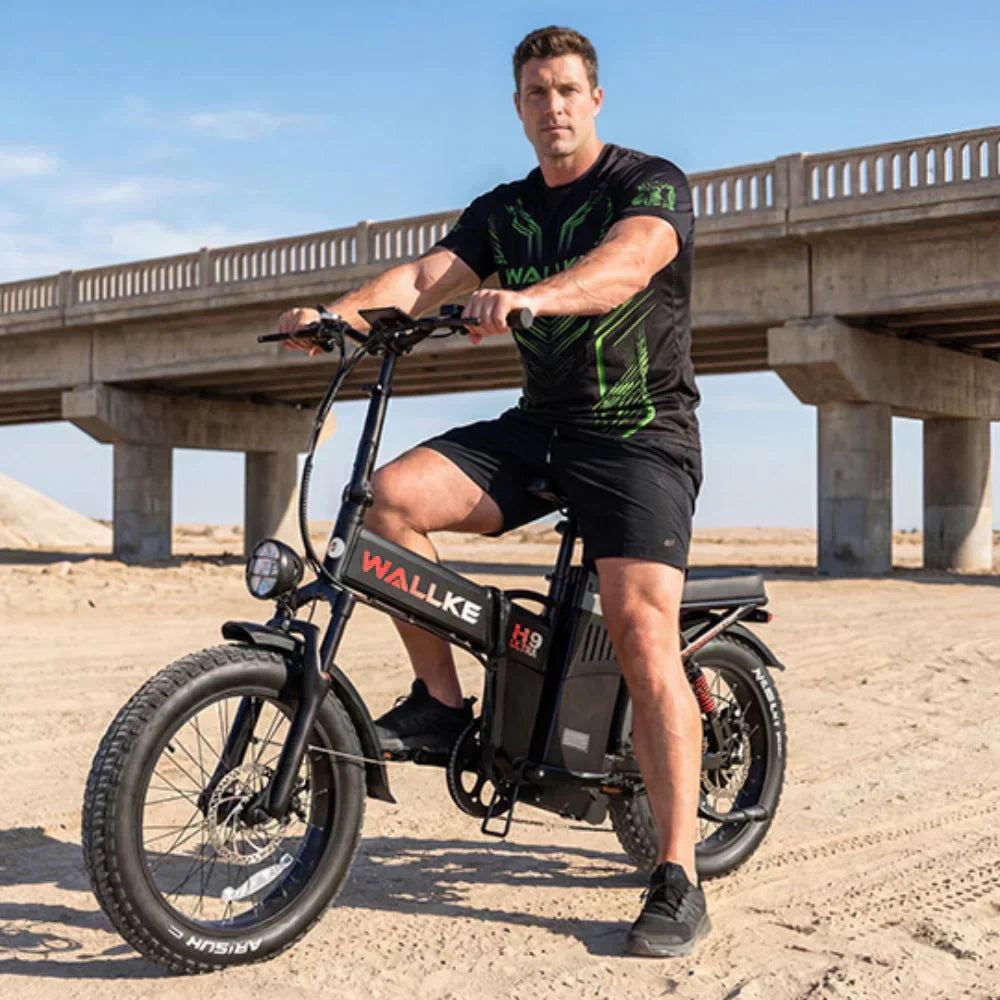
| Wallke H9 AWD | Active dual-motor AWD platform with a 48V 40Ah battery configuration, 20 x 4.0 all-terrain fat tires, hydraulic disc brakes with 203 x 2.8 mm rotors, full suspension, and a 400 lb payload rating. | Loose or mixed sand, heavier loads, cargo, and riders who prioritize maximum traction. |
| Wallke H7 AWD | Uses the active H7/H9 AWD platform while adding a step-through frame for easier mounting, frequent stops, and carrying beach equipment. It also uses 20 x 4.0 fat tires and a 400 lb payload rating. | Riders who want AWD traction with easier frame access and stable low-speed handling. |
| Wallke H9 Ultra | Single rear-motor reference option with a torque sensor, 48V 55Ah / 2640Wh battery configuration, 20 x 4.0 tires, four-piston hydraulic brakes with 203 x 2.8 mm rotors, full suspension, and a 400 lb payload rating. | Hard-packed sand and longer mixed road-and-coast rides where smooth pedal response and battery capacity matter. Availability may vary. |
Shop the current AWD options
Wallke H9 AWD
Best overall Wallke fit for riders prioritizing dual-motor traction and a folding frame.
Wallke H7 AWD
Best Wallke fit for riders who want AWD traction with a step-through frame.
Compare Wallke fat tire options: Start with the Wallke fat tire e-bike collection, then review dual motor e-bikes when traction is the main priority.
How to Ride and Set Up an E-Bike on Sand
- Lower tire pressure cautiously. A larger contact patch improves flotation, but pressure that is too low can cause tire roll, rim strikes, or vague steering.
- Build power smoothly. Avoid sudden throttle bursts that spin the tires and dig holes.
- Keep momentum. Use steady cadence and gentle steering rather than sharp turns.
- Shift before loose sections. Enter soft sand in an easier gear and moderate assist level.
- Avoid stopping in deep sand. Restarting creates the highest traction and battery demand.
- Choose firm sand when legal. Damp, compacted sand is generally easier than dry upper-beach sand.
- Protect the battery reserve. Turn around earlier than you would on pavement because the return trip may include headwind or softer conditions.
Sand, Salt, and Post-Ride Maintenance
Beach riding is hard on drivetrains, brake components, bearings, fasteners, and electrical connections. Sand acts as an abrasive, while salt residue accelerates corrosion. Never treat an e-bike as waterproof or ride it through seawater.
- Allow wet sand to drain before transporting the bike.
- Brush or gently rinse away loose sand and salt residue.
- Do not use a pressure washer around the motor, battery, display, bearings, or connectors.
- Dry the frame, drivetrain, brake area, and exposed hardware.
- Inspect the chain, cassette, brake rotors, tire tread, and electrical contact areas.
- Lubricate the chain only after it is clean and dry; keep lubricant away from brake rotors and pads.
For longer-term battery care, review Wallke's long-range e-bike battery care guide.
Mistakes to Avoid Before Riding on Sand
- Buying only by top speed. Traction, power control, battery reserve, and braking matter more on sand.
- Assuming AWD prevents every stall. Deep sand can stop any heavy bike.
- Running pavement pressure. Excess pressure reduces the contact patch and flotation.
- Lowering pressure too far. Extremely low pressure can damage the tire, tube, or rim.
- Ignoring total payload. Include the rider and every item of beach gear.
- Riding through saltwater. Direct saltwater exposure can damage mechanical and electrical components.
- Assuming every beach allows e-bikes. Permission for bicycles does not always include every e-bike configuration.
Beach Access and High-Power E-Bike Rules
Before riding, confirm whether e-bikes are permitted on the exact beach, path, park, or public land. Rules can vary by state, city, land manager, motor rating, throttle use, assisted speed, and e-bike class.
Some high-power e-bikes may fall outside standard Class 1, Class 2, or Class 3 access rules. A model suitable for private property or designated off-road riding may not be permitted on a public beach path. Use the legal configuration required for the location and obey posted speed limits.
- Stay off dunes, nesting areas, protected vegetation, and closed sections.
- Yield to pedestrians, children, dogs, anglers, horses, and maintenance vehicles.
- Reduce speed near blind entrances and crowded beach access points.
- Carry a tire gauge, basic tools, water, and a way to contact help.
- Use lights and reflective equipment in fog, low light, or near sunrise and sunset.
For broader mixed-terrain buying considerations, see the off-road e-bike buying guide.
Final Verdict: Choosing the Best E-Bike for Sand
The best e-bike for sand is the one that fits the terrain you will actually ride. For hard-packed beach sand and long coastal routes, prioritize 4-inch fat tires, smooth assistance, hydraulic brakes, and enough battery reserve. For soft patches, heavier loads, cargo, or frequent starts, add stronger low-speed torque and consider dual-motor AWD traction.
Within Wallke's current lineup, H9 AWD is the strongest overall traction-focused option, while H7 AWD provides similar AWD intent with easier step-through access. H9 Ultra remains a useful long-range single-motor reference for packed sand and mixed coastal riding, but availability should be checked before treating it as a final purchase option.
The smartest purchase is not the most aggressive-looking bike. It is the bike that provides predictable control, adequate range, braking confidence, correct rider fit, and legal access to the beach terrain you plan to use.
FAQ: E-Bikes for Sand and Beach Riding
What is the best e-bike for sand?
The best e-bike for sand depends on the surface. For hard-packed beach sand, a stable single-motor e-bike with 4-inch fat tires, hydraulic brakes, and a large battery may be enough. For loose or mixed sand, heavier loads, or frequent starts, a dual-motor AWD fat tire e-bike can provide more traction and help the bike maintain momentum.
Can you ride an e-bike on sand?
Yes. E-bikes can ride on firm, damp, hard-packed sand more easily than on deep, dry sand. Fat tires, moderate tire pressure, smooth power delivery, and steady momentum help. Always confirm that e-bikes are permitted at the specific beach or public access area.
What electric bike can ride on sand?
A sand-capable electric bike should have approximately 4-inch or wider tires, controlled power delivery, adequate torque, a battery sized for high-load riding, hydraulic disc brakes, and a sturdy frame. Dual-motor traction is useful for loose patches but is not necessary for every hard-packed beach route.
What is the best e-bike for soft sand?
For soft sand, prioritize wide tires, lower pressure within the tire manufacturer's safe range, strong low-speed torque, a large battery, and controlled dual-motor or AWD traction. Even a capable e-bike can bog down in deep powdery sand, so route choice and riding technique still matter.
Are fat tires good for beach sand?
Yes. Fat tires spread the weight of the bike and rider across a larger contact patch, which improves flotation and traction. They work best on firm or moderately soft sand, but no tire completely removes the difficulty of deep, dry sand.
Is a dual-motor e-bike better for sand?
A dual-motor or AWD e-bike can be better when riding through loose patches, carrying beach gear, supporting a heavier total load, or starting on uneven sand. The tradeoffs are extra weight, higher battery use, and possible access restrictions for high-power configurations.
What tire pressure should I use on sand?
Use less pressure than you would on pavement only when the tire and rim manufacturer allow it. Lower pressure increases the contact patch, but going too low can cause vague steering, tire roll, pinch damage, or rim strikes. Start conservatively and adjust in small steps.
Does riding on sand reduce e-bike range?
Yes. Sand creates more rolling resistance, so the motor draws more energy than it does on pavement. Soft sand, low tire pressure, headwinds, cargo, rider weight, frequent starts, and dual-motor use can all reduce real-world range.
How do I clean an e-bike after riding near sand or saltwater?
Remove loose sand, gently rinse salt residue without using a pressure washer, dry the bike carefully, inspect the drivetrain and brakes, and lubricate the chain as needed. Do not direct high-pressure water at bearings, the motor, display, battery contacts, or electrical connectors.
Are electric bikes allowed on beaches?
Rules vary by beach, city, state, park, and land manager. Some locations allow bicycles but restrict e-bikes, throttles, high-power configurations, or riding above certain speeds. Check posted signs and the current rules for the exact beach before riding.


Leave a comment